
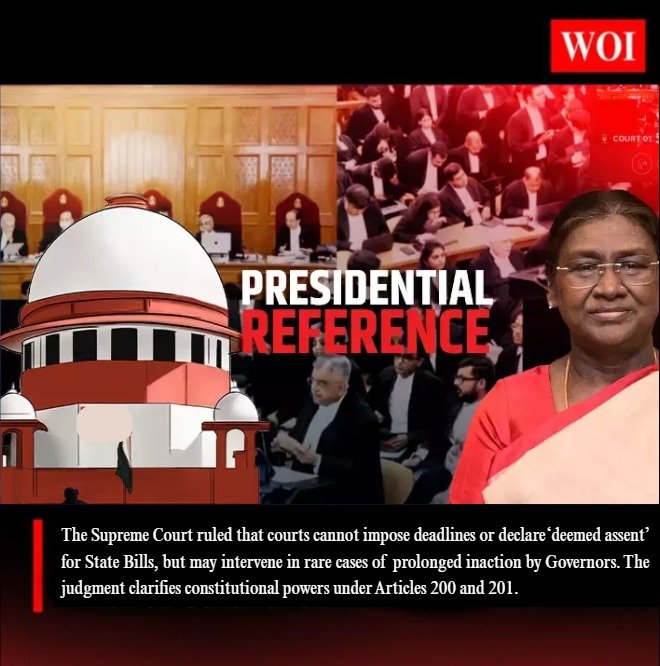
The Supreme Court has delivered a detailed advisory opinion on the constitutional powers of the President and Governors regarding their decisions on State Bills. Responding to a Presidential Reference under Article 143, a five-judge Bench ruled that courts cannot impose deadlines or create a doctrine of ‘deemed assent’ for pending Bills.
No Judicial Timelines for Assent
The Court emphasised that the Constitution does not specify any fixed time limits under Articles 200 and 201 for the President or Governors to act on Bills. Imposing such deadlines would amount to altering the constitutional design and violating the separation of powers. Therefore, courts have no authority to prescribe mandatory timelines for assent.
Judicial Review in Extreme Cases Only
While courts cannot direct time-bound decisions, the Bench allowed limited judicial intervention in rare situations where the Governor displays prolonged, unexplained or indefinite inaction. In such cases, courts may issue a restricted mandamus directing the Governor to act within a reasonable time, without evaluating the merits of the decision.
Governor’s Options Under Article 200
The Court reiterated the constitutional choices available to a Governor when presented with a Bill:
- Grant assent
- Withhold assent or return the Bill with comments (except Money Bills)
- Reserve the Bill for the consideration of the President
However, the Court made it clear that a Governor cannot sit indefinitely on a Bill without returning it, as such inaction disrupts the legislative process and weakens the federal structure.
