
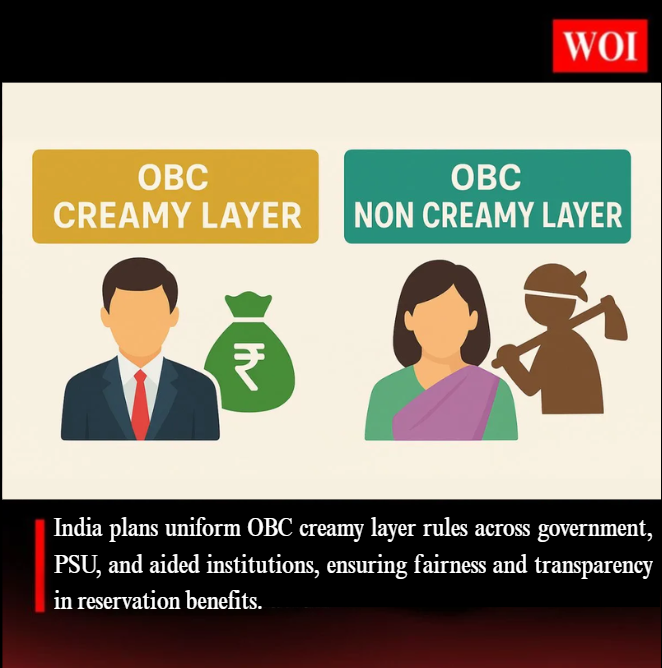
The government is working to bring uniformity in applying the ‘creamy layer’ concept for Other Backward Class (OBC) reservations across central and state jobs, public sector units, universities, and aided institutions. The move follows consultations with ministries, NITI Aayog, and the National Commission for Backward Classes (NCBC), aiming to ensure fairness and clarity in eligibility.
Background
The creamy layer principle, upheld by the Supreme Court in the Indra Sawhney judgment (1992), excludes affluent OBCs from reservation benefits. Guidelines issued in 1993 set income and job-based exclusions, with the current income ceiling at ₹8 lakh (excluding agriculture income).
Current Challenge
Over the years, inconsistent application of rules has led to anomalies. For example, children of university professors or PSU officials may be classified differently from central government officers of similar rank.
Proposed Reform
The government now seeks to establish equivalence across job categories and pay scales. This will harmonize treatment of employees in state bodies, aided institutions, and PSUs with central services, while private sector OBC candidates will continue under income-based assessment.
Impact
The policy, once finalised, will bring transparency, reduce disputes in caste certificate scrutiny, and ensure a balanced approach to social justice and fairness in reservation policies.
