
Hyderabad:
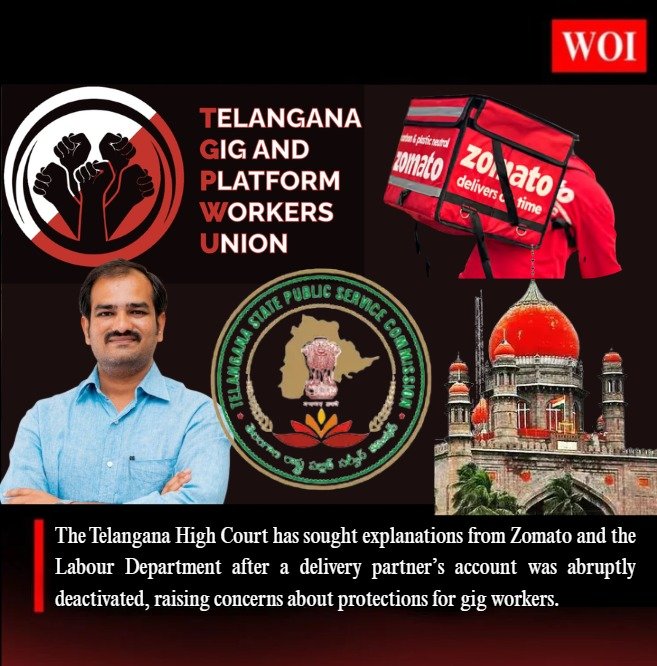
The Telangana High Court has sought an explanation from Zomato and the State Labour Department over the abrupt deactivation of a delivery partner’s account, raising serious concerns about the lack of safeguards for gig workers in the state.
Justice Nagesh Bheemapaka issued notices to Zomato India Pvt. Ltd., the State government, and the Labour Commissioner while hearing W.P. No. 36194 of 2025, filed by Mohd. Khaleel Ahmed Baag. The petitioner contends that his account was switched off without prior warning or any form of inquiry, effectively cutting off his sole source of income.
Khaleel, 35, was earning around Rs. 15,000 per month through the platform and maintained a strong performance rating of 4.85. However, on November 7 last year, his worker ID was blocked on what the company termed as a “behavioural issue.” The petition states that no evidence was disclosed nor was the worker given a chance to respond before the platform ended his access.
When Khaleel approached Zomato’s Hyderabad office seeking an explanation, he was allegedly informed that his association with the company had ended. He subsequently lodged a formal complaint with the Labour Commissioner in December. Though the Joint Commissioner of Labour issued two notices calling for a joint hearing, Zomato reportedly failed to participate in the proceedings.
With administrative remedies exhausted, Khaleel filed a petition before the High Court, arguing that the action violated his fundamental right to livelihood and equality under the Constitution.
Arguing on his behalf, advocate Syed Mounis Abidi submitted that companies operating through digital platforms cannot function beyond the reach of labour laws and constitutional safeguards. He also questioned the Labour Department’s failure to enforce compliance when the company ignored official notices.
The Telangana Gig and Platform Workers Union welcomed the court’s intervention, calling it a necessary step toward accountability in the platform economy. The union criticised the practice of instant deactivations without explanation and said such actions expose workers and their families to financial ruin overnight.
The union further pointed out that although gig workers are recognised under the Code on Social Security, 2020, the lack of enforcement mechanisms allows companies to exercise unchecked control over employment through mobile applications.
Demanding corrective measures, the union called for Khaleel’s immediate reinstatement, compensation for loss of income, and the creation of a legally mandated grievance redressal system. It also urged the government to formally recognise gig workers as workers in substance and not merely as contractual users of an app.
TGPWU founder president Shaik Salahuddin said the case represents a wider struggle for dignity and justice in the digital workforce and could prove decisive for thousands of workers facing similar uncertainty.
