
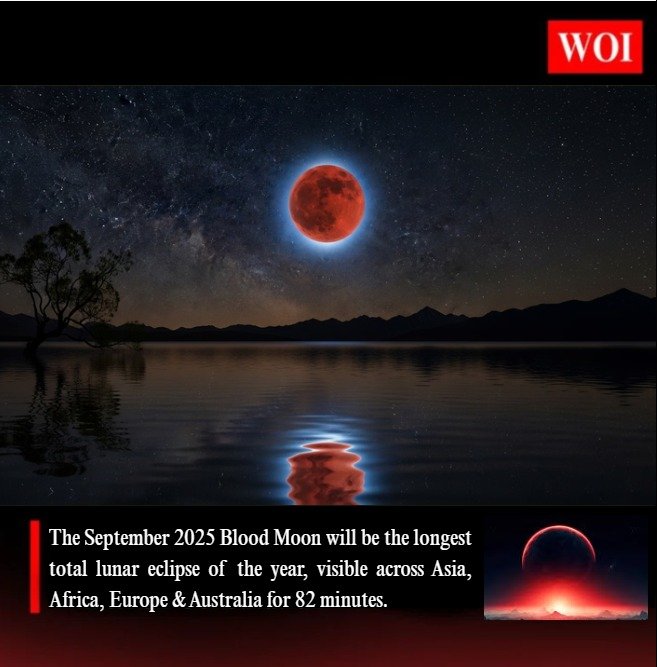
On the night of September 7–8, 2025, skywatchers across Asia, Africa, Europe, and Australia will witness a spectacular total lunar eclipse, popularly called a Blood Moon. For 82 minutes, the Moon will glow a dramatic deep red—making it the longest total lunar eclipse of 2025.
What Is a Blood Moon?
A Blood Moon occurs when Earth aligns between the Sun and the Moon, casting its shadow across the lunar surface. Instead of vanishing, the Moon shines red because Earth’s atmosphere scatters blue light and bends red wavelengths toward the Moon—similar to a sunset.
Eclipse Timeline (UTC)
- Penumbral Eclipse Begins: 15:28
- Partial Eclipse Begins: 16:27
- Totality Begins: 17:30
- Maximum Eclipse: 18:11
- Totality Ends: 18:52
- Partial Eclipse Ends: 19:56
- Penumbral Eclipse Ends: 20:55
Where to Watch
- Best visibility: Asia, Australia, eastern Africa, much of Europe
- Not visible: North and South America (daytime skies)
- Live streams: TimeandDate.com, Virtual Telescope Project, and NASA
How to View
The eclipse is safe to watch with the naked eye. For the best experience:
- Find a dark spot away from city lights
- Use binoculars/telescopes for lunar details
- Hope for clear skies
Why It Matters
This event combines science, culture, and beauty:
- Longest eclipse of 2025 (82 minutes of totality)
- Helps study Earth’s atmosphere through lunar color
- Coincides with the Harvest Moon, tied to seasonal traditions
For millions across the Eastern Hemisphere, this Blood Moon will be both a celestial spectacle and a rare scientific opportunity.
