
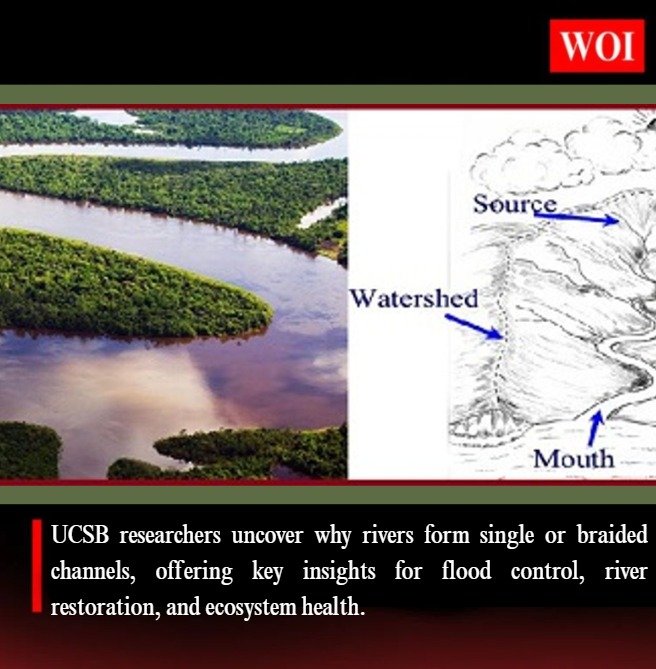
Geographers at the University of California, Santa Barbara (UCSB) have solved a long-standing puzzle in river science: why some rivers flow as a single channel while others branch into multiple streams.
Using 36 years of Landsat satellite data from 84 rivers worldwide, researchers discovered that single-thread rivers maintain balance between bank erosion and sediment deposition, keeping channels stable. In contrast, braided rivers erode banks faster than they deposit sediment, causing them to widen and split repeatedly.
The study also highlighted the role of vegetation—vegetated bends move laterally and form levees, while unvegetated bends drift downstream, altering river stability. Case studies of the Ganga and Brahmaputra showed how rapid erosion drives channel splitting, challenging earlier assumptions of equilibrium in braided rivers.
Human interference—dams, embankments, and mining—often forces braided rivers into single channels, increasing flood risks. The research stresses the need for nature-based restoration, such as reconnecting floodplains and adding vegetated buffers.
This knowledge is crucial for improving flood management, biodiversity conservation, and river restoration, especially in dynamic systems like India’s major rivers.
