
By Soniya:
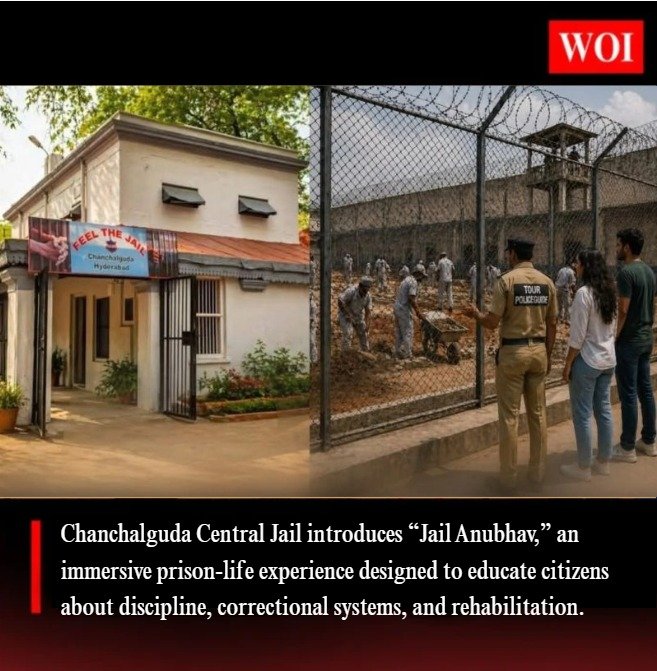
In a remarkable and first-of-its-kind initiative in Telangana, the historic Chanchalguda Central Jail has opened its gates to ordinary citizens through an immersive public awareness programme called “Jail Anubhav.”
Launched at the newly inaugurated Telangana Prisons Museum inside the State Institute of Correctional Administration (SICA), the initiative is designed to give people a realistic understanding of prison life, discipline, punishment, and rehabilitation.
Far from being a tourist attraction, officials describe the programme as a social awareness experiment — one that attempts to educate citizens, especially youth, about the consequences of crime and the importance of lawful conduct.
A 12-Hour Experience Inside Prison Walls
Under the “Jail Anubhav” programme, participants voluntarily spend nearly 12 hours inside specially designed prison barracks, following routines similar to those experienced by inmates.
From wearing prison uniforms to eating jail meals and observing strict schedules, the programme recreates the emotional and psychological atmosphere of incarceration.
What Participants Experience
Those taking part in the programme will:
- Wear jail uniforms
- Eat standard prison meals
- Stay inside prison barracks
- Follow strict prison discipline
- Observe inmate routines
- Experience simulated solitary confinement
- Learn about rehabilitation and correctional systems
The timings for the experience are scheduled from 6:00 AM to 6:00 PM, with a participation fee of ₹1,000 per person. Entry is restricted to individuals above 18 years of age.
Meal timings are structured exactly like prison schedules:
- Breakfast: 7:00 AM – 8:00 AM
- Lunch: 12:00 PM
- Dinner: 5:00 PM – 6:00 PM
Officials say the goal is not fear, but awareness — helping citizens understand how prison systems function and how discipline shapes correctional environments.
From Nizam-Era Prison to Public Education Centre
Established during the Nizam period, Chanchalguda Central Jail remains one of India’s oldest and most recognized prisons.
For decades, its walls witnessed:
- freedom struggle detentions,
- political imprisonment,
- high-profile criminal cases,
- and major correctional reforms.
Once viewed purely as a symbol of punishment and isolation, the prison is now gradually transforming into a space for public education and rehabilitation awareness.
The newly inaugurated Telangana Prison Museum further strengthens this transformation.
Inside the Telangana Prison Museum
The museum presents a detailed journey through the history of punishment, prison administration, and reform systems in India.
Visitors can explore:
- Ancient punishment instruments
- Chains, shackles, and gallows
- Historical prison barrack recreations
- Rare paintings and prison artefacts
- Audio-visual presentations
- Rehabilitation and correctional reform exhibits
The museum attempts to show how prisons evolved from torture-oriented institutions into systems increasingly focused on rehabilitation and reintegration into society.
Cinema, Curiosity and the Reality of Jail Life
Interestingly, the initiative has sparked comparisons with prison scenes from Indian cinema.
Many social media users drew parallels with the humorous prison sequences from Jathi Ratnalu, while others recalled classics like Poola Rangadu, which reportedly filmed prison scenes inside Chanchalguda and Musheerabad jails.
Films such as 3 Deewarein and Swathanthryam Ardharathriyil also explored the emotional and psychological dimensions of prison life, portraying incarceration as more than physical confinement.
These cinematic references have increased public curiosity about the programme while also reminding audiences that prisons are often spaces of fear, regret, discipline, survival, and transformation.
Why the Initiative Matters
According to Telangana prison officials, the larger objective is social awareness.
The programme aims to:
- Build awareness among young people
- Encourage respect for law and discipline
- Demonstrate the consequences of crime
- Explain modern correctional systems
- Reduce misconceptions about prisons
Authorities believe that exposing citizens to the realities of prison life could discourage criminal behaviour while simultaneously creating empathy toward rehabilitation systems.
A Symbolic Shift in Public Thinking
For generations, prison walls symbolized silence, punishment, and fear.
Today, Chanchalguda is attempting to reshape that perception by opening conversations around reform, accountability, and social responsibility.
The “Jail Anubhav” initiative reflects a broader shift in how modern correctional systems are being viewed — not merely as places of confinement, but as institutions that can educate, reform, and reconnect individuals with society.
In many ways, the programme is not just about experiencing prison life.
It is about understanding the value of freedom, discipline, responsibility, and lawful living before mistakes lead someone behind real prison bars.
