
By Soniya:
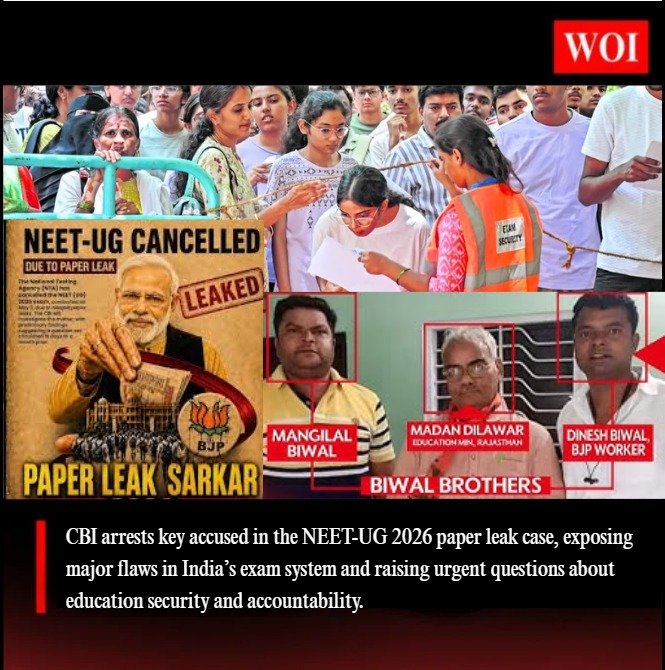
India’s competitive examination system is once again under scrutiny after the Central Bureau of Investigation (CBI) arrested multiple individuals in connection with the alleged NEET-UG 2026 biology and chemistry paper leak case. What began as another investigation into malpractice has now exposed deeper concerns about the credibility, security, and integrity of India’s entrance examination ecosystem.
The latest developments have shocked students and parents across the country because NEET is not just another exam — it is the gateway to medical education and one of the most competitive entrance tests in India.
How the Alleged NEET-UG 2026 Leak Operated
According to the CBI, a biology lecturer from Pune who had been appointed by the National Testing Agency (NTA) as an expert allegedly misused her position during the examination process. Investigators claim she had direct access to botany and zoology question papers and conducted “special coaching sessions” for selected candidates at her residence.
The agency alleges that during these sessions, students were allegedly instructed to note down likely questions and mark important answers in textbooks. A majority of those questions reportedly matched the actual NEET-UG 2026 paper held on May 3.
The CBI has also arrested a chemistry lecturer, who allegedly followed a similar method by dictating chemistry questions and answers to students before the examination.
So far, nine people have been arrested in the case, including intermediaries, coaching-linked individuals, and alleged facilitators from multiple states.
Why Repeated Paper Leaks Are Becoming a National Crisis
India has witnessed repeated examination leaks over the past decade involving recruitment exams, state public service commissions, teacher eligibility tests, police recruitment exams, and national entrance tests.
Major controversies in recent years have included:
- NEET controversies and impersonation cases
- SSC recruitment paper leaks
- Railway recruitment exam irregularities
- Teacher recruitment scams in multiple states
- State-level police and constable recruitment leaks
- Public Service Commission examination scandals
Each incident damages public trust and creates psychological trauma for lakhs of students who spend years preparing honestly.
For middle-class and rural families especially, competitive exams are often viewed as the only pathway toward economic stability and social mobility. When question papers leak, students lose confidence not only in examinations but in the fairness of the entire system.
Why Paper Leaks Keep Happening
Experts believe paper leaks continue because of a dangerous combination of factors:
- Weak digital security systems
- Insider access to confidential question papers
- Corruption networks involving middlemen
- Lack of accountability within institutions
- Delayed investigations and slow convictions
- Commercialization of coaching ecosystems
- High-pressure competitive environments
In many cases, insiders within the examination system become the biggest vulnerability.
The latest NEET case is particularly alarming because the accused allegedly had official access through the examination process itself.
What Questions Must Be Asked to the Government?
The latest controversy raises several direct questions that governments and examination authorities can no longer avoid:
- Why do sensitive national examinations still face repeated security failures?
- How are confidential paper setters and experts selected and monitored?
- Why is there no fully transparent digital audit trail system for paper access?
- Why do investigations often begin only after leaks are already widespread?
- Why are students repeatedly forced to suffer because of institutional negligence?
- Should India establish an independent National Examination Security Authority?
These are no longer isolated incidents. They point toward systemic weaknesses.
What Reforms Are Needed Immediately?
Experts and education activists have suggested several urgent reforms:
1. End-to-End Digital Encryption
Question papers should remain encrypted until the final authorized opening window.
2. Real-Time Monitoring
Every individual accessing examination material should be digitally tracked.
3. Stronger Background Verification
Experts, evaluators, and confidential staff should undergo strict vetting.
4. Fast-Track Courts
Paper leak cases should be resolved within months, not years.
5. Lifetime Debarment
Individuals involved in exam fraud should face permanent bans from educational and government institutions.
6. Independent Exam Security Authority
A specialized national body may be needed to oversee examination integrity across India.
Students Are Losing More Than Marks
For lakhs of students, competitive exams represent years of sacrifice, financial pressure, emotional stress, and family expectations.
When examination systems fail, the damage goes beyond ranks and admissions. It weakens faith in meritocracy itself.
The NEET-UG 2026 case is not just about one leaked paper or one coaching network. It is becoming a larger test of whether India can protect fairness in one of the world’s largest education systems.
Until stronger accountability and structural reforms are implemented, students may continue paying the price for failures they never created.
