
By Soniya:
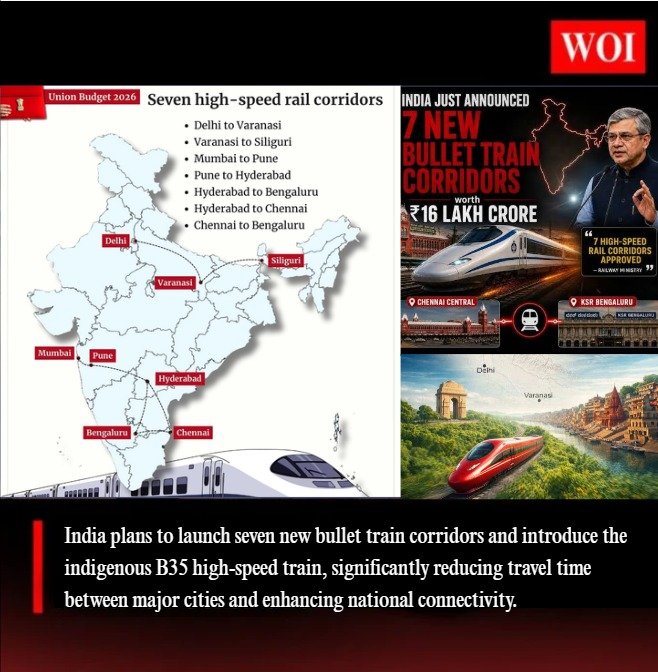
India is set to expand its high-speed rail network with seven proposed bullet train corridors connecting major metropolitan cities. The initiative is part of the country’s vision to strengthen connectivity, reduce travel time, and boost economic growth through modern transportation infrastructure.
The proposed corridors include Mumbai–Pune, Pune–Hyderabad, Hyderabad–Bengaluru, Hyderabad–Chennai, Bengaluru–Chennai, Delhi–Varanasi, and Varanasi–Siliguri. These routes are expected to drastically cut travel times, with Mumbai–Pune covered in just 48 minutes and Bengaluru–Chennai in only 73 minutes.
To support the expansion, the National High Speed Rail Corporation Limited (NHSRCL) is developing the indigenous B35 Bullet Train. Designed and manufactured in India, the train will have a maximum speed of 350 km/h and an operational speed of 320 km/h, featuring advanced safety systems, modern signalling, and enhanced passenger comfort.
Meanwhile, India’s first high-speed rail project, the Mumbai–Ahmedabad Bullet Train Corridor, is progressing rapidly. The 97-km Surat–Vapi section is expected to become operational by August 2027, marking a major milestone in India’s bullet train journey.
The proposed network is expected to improve regional connectivity, reduce dependence on short-haul flights, generate employment, and strengthen economic integration across key growth corridors, paving the way for a faster and more connected India.
