
Telangana’s Gig Workers Have a New Worry: Earning Enough to Keep Going
As app-based drivers push for fair fares, incentives and social security, AIPC Telangana takes their concerns to the Labour Minister
Hyderabad |
For an app-based driver, the calculation begins long before a passenger gets into the car.
There is the fuel to pay for, the vehicle to maintain, commissions to account for and hours to spend on the road. What remains at the end of the day is the actual income. And for a growing number of drivers and delivery workers in Telangana, that final number is becoming the most important part of the conversation around the state’s expanding gig economy.
The concerns of these workers have now reached the state government.
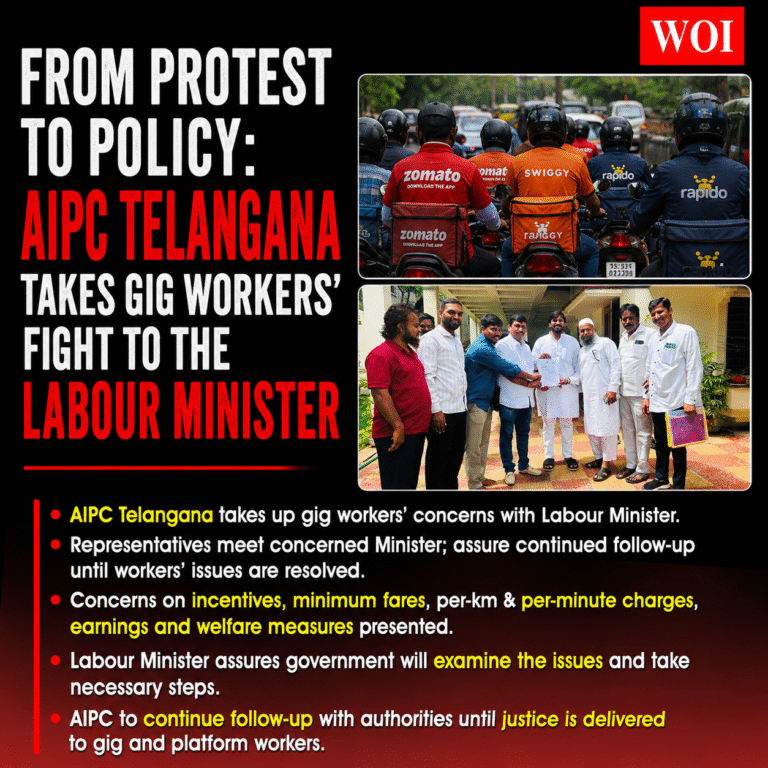
The All India Professionals’ Congress (AIPC) Telangana has taken up issues raised by app-based drivers and other platform workers with Labour Minister Dr. G. Vivek Venkataswamy, seeking government intervention on fares, incentives, earnings and welfare measures.
An AIPC delegation led by State President Dr. Aditya Gillella, along with State Head for Gig Workers Shri Syed Abdul Rawoof and Deputy State Head Architect Bharat Reddy, met the minister and placed the workers’ concerns before him.
At the heart of the discussion was a question that is increasingly difficult to ignore: How sustainable is gig work when the cost of doing the job continues to rise but earnings remain uncertain?
The fare question
Drivers and delivery workers have been raising concerns over minimum fares, per-kilometre and per-minute charges and incentive structures offered by app-based companies.
For workers who spend most of their working day on the road, these are not merely technical issues involving tariff calculations. They determine their daily earnings.
A change in an incentive slab, a reduction in the effective fare or an increase in operating costs can directly affect what a driver takes home.
The AIPC delegation therefore urged the Labour Minister to examine the concerns and ensure that the interests of workers are considered while the government moves ahead with its policy on gig and platform workers.
The minister, according to AIPC Telangana, assured the delegation that the issues would be examined and that necessary steps would be considered regarding incentives and other concerns raised by the workers.
A larger policy shift is already under way
The meeting comes at a significant time for Telangana.
The state has already taken legislative steps towards creating a formal welfare framework for platform-based workers. The Telangana Assembly passed the Telangana Platform-Based Gig Workers (Registration, Social Security and Welfare) Bill, 2026, providing for registration of workers, a welfare board and social-security measures.
The legislation is significant because it attempts to recognise a workforce that traditionally operated outside the conventional employer-employee relationship.
But passing a law is only the first step.
For workers, the real question is how quickly the provisions translate into something tangible—better protection, access to welfare schemes, transparency in payments and greater financial security.
That gap between policy and implementation is likely to remain one of the biggest challenges facing Telangana’s gig economy.
 From protest to negotiation
The latest intervention also follows growing mobilisation among app-based workers in the state.
The Telangana App-Based Drivers Forum (TADF) had announced protest action over issues including minimum fares, per-kilometre and per-minute rates, implementation of gig and platform worker rules and the creation of a welfare mechanism.
The workers have also demanded minimum fares in line with the Motor Vehicle Aggregator Guidelines, 2025.
The protests brought the concerns of drivers and delivery workers into sharper public focus and increased pressure for a government response.
With the Labour Minister now assuring representatives that the issues will be examined, the immediate confrontation has opened a window for dialogue.
But workers are likely to judge the process not by assurances alone, but by what eventually changes in their earnings and working conditions.
Why this matters beyond the gig economy
The gig economy is no longer a marginal part of urban India.
From cabs and food delivery to logistics and home-based services, app-driven work has become part of everyday life. Consumers see convenience. Platforms see scale. Workers see an increasingly competitive livelihood.
That makes the debate over gig workers larger than a dispute about fares.
It raises questions about who carries the economic risk when work is controlled by digital platforms.
If a worker owns or finances the vehicle, pays for fuel, spends hours waiting for orders and depends on an algorithm for the next assignment, where does responsibility for social security begin?
That is precisely the policy challenge governments across India are beginning to confront.
 AIPC promises to stay with the issue
 AIPC promises to stay with the issue
For AIPC Telangana, the meeting with the Labour Minister is being positioned as the beginning of a longer engagement rather than the end of the matter.
The organisation has assured gig workers that it will continue following up with the Labour Department and other concerned authorities and pursue their demands until appropriate action is taken.
The focus, according to the organisation, will remain on fares, incentives, earnings, welfare and social-security measures.
The intervention also puts the spotlight on the need for workers’ voices to be part of the implementation process.
The road ahead
Telangana has already taken an important legislative step towards recognising the rights and welfare of platform workers. The next challenge is turning that framework into something workers can feel in their everyday lives.
For a driver beginning another 10-hour shift, the question is ultimately simple.
After the fuel bill, vehicle expenses, platform deductions and hours spent behind the wheel, is the work still worth it?
The answer will depend not on policy announcements alone, but on whether Telangana can build a gig economy in which flexibility does not come at the cost of dignity, security and a fair livelihood.
For now, the government has agreed to examine the concerns.
