
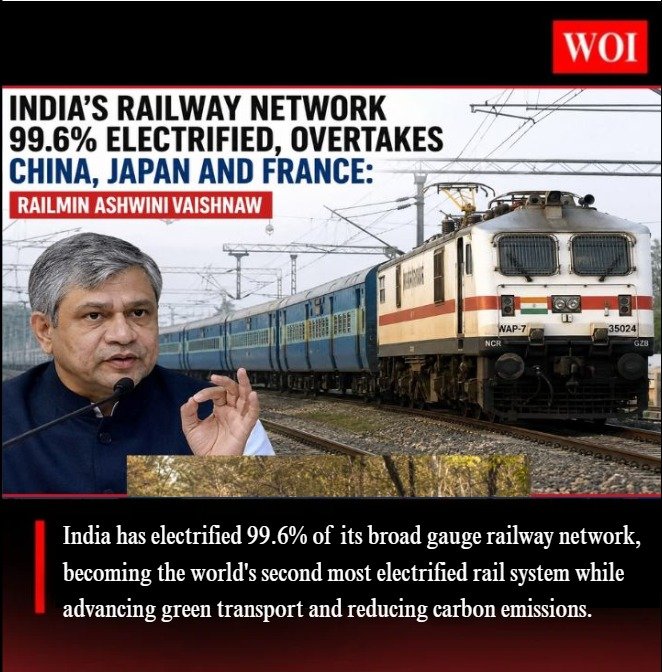
India has achieved a major milestone in railway modernization by electrifying 99.6% of its broad gauge (BG) railway network, making Indian Railways the world’s second most electrified rail network after Switzerland. According to the Ministry of Railways, this accomplishment reflects one of the fastest and largest railway electrification drives globally and marks significant progress toward sustainable and energy-efficient transportation.
Since 2014, India has accelerated railway electrification at an unprecedented pace, electrifying over 48,000 route kilometres, more than doubling the total electrified network achieved in the previous six decades. Today, nearly all new railway lines and track expansion projects are being developed with electrification from the outset, reducing dependence on fossil fuels and improving operational efficiency.
The shift to electric traction has also delivered substantial environmental benefits. Indian Railways has reduced diesel consumption from 293 crore litres in 2015-16 to 108 crore litres in 2024-25, saving fuel costs and lowering carbon emissions. According to NITI Aayog, rail transport emits nearly 89% less carbon dioxide per tonne-kilometre than road transport, making it one of the cleanest modes of freight movement.
Supporting its green transition, Indian Railways has installed over 1,260 MW of renewable energy capacity, including 1,161 MW of solar and 103 MW of wind power, while several railway zones and states have already achieved 100% railway electrification. The achievement strengthens India’s commitment to sustainable transport, energy security, and its long-term net-zero emissions goals.
