
By Soniya:
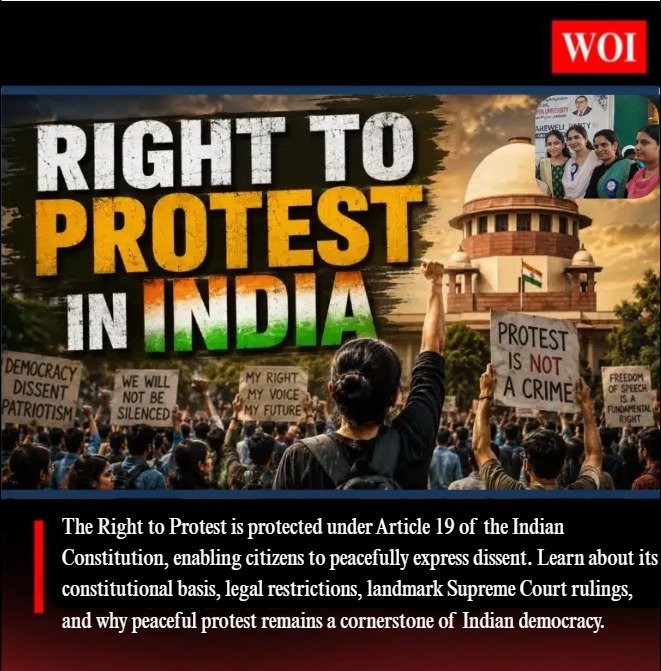
New Delhi: The Right to Protest is a fundamental pillar of India’s democratic framework, allowing citizens to peacefully express their opinions, dissent against government policies, and demand accountability. Rooted in Article 19 of the Constitution, the right protects freedom of speech and peaceful assembly, while also permitting the government to impose reasonable restrictions to maintain public order, national security, and public safety.
Under Article 19(1)(a), every citizen has the right to freedom of speech and expression, while Article 19(1)(b) guarantees the right to assemble peacefully without arms. However, these rights are subject to reasonable restrictions under Articles 19(2) and 19(3) in the interest of India’s sovereignty, public order, decency, security of the State, and prevention of incitement to offences.
The Supreme Court of India has repeatedly upheld the constitutional importance of peaceful protests while clarifying that demonstrations must remain lawful and should not infringe upon the rights of others. In landmark judgments such as Himat Lal K. Shah v. Commissioner of Police (1973), Mazdoor Kisan Shakti Sangathan v. Union of India (2018), and Amit Sahni v. Commissioner of Police (2020), the Court ruled that while peaceful protest is a constitutional right, authorities may regulate the time, place, and manner of demonstrations to ensure public convenience and safety.
Public protests in India generally require prior permission from local authorities and are often restricted to designated locations such as Jantar Mantar in New Delhi. The administration may also impose prohibitory orders under applicable laws during situations affecting public order.
Peaceful protests have played a significant role in India’s democratic journey, from the freedom movement led by Mahatma Gandhi to contemporary social and policy reforms. While citizens have the constitutional right to voice their concerns, the legal framework seeks to balance this freedom with the rights of other citizens, uninterrupted public services, and national security.
The constitutional guarantee of peaceful protest, supported by judicial safeguards, continues to remain an essential feature of India’s democracy, reinforcing both citizens’ rights and the rule of law.
