
BY Shashank Pasupuleti
TPCC leader says faster dispute resolution is welcome, but calls for wider reforms on credit access, compliance burden and growth of small enterprises
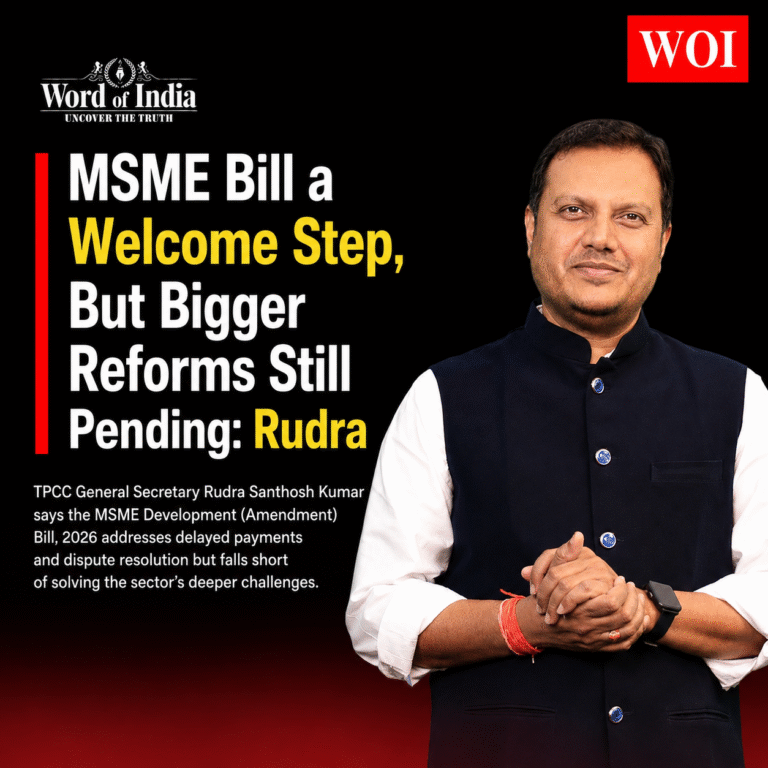
HYDERABAD, August 8: The Micro, Small and Medium Enterprises Development (Amendment) Bill, 2026 addresses some longstanding concerns over delayed payments and dispute resolution, but does not sufficiently deal with the larger structural challenges faced by the MSME sector, TPCC General Secretary and AICC National Coordinator Rudra Santhosh Kumar said.
In a statement, Kumar said measures intended to speed up payments, strengthen recovery of dues and reduce delays in dispute settlement were necessary, particularly for micro and small enterprises that often operate with limited working capital.
He said the proposed strengthening of the Trade Receivables Discounting System (TReDS) could help MSME suppliers obtain liquidity against pending invoices instead of waiting for buyers to clear payments.
Kumar also referred to provisions prescribing timelines for mediation and arbitration in payment disputes, saying quicker resolution could provide relief to enterprises that otherwise spend considerable time pursuing outstanding dues.
However, he said the effectiveness of these provisions would ultimately depend on implementation.
“Putting a timeline in the law is important, but the real question is whether the institutional machinery responsible for resolving disputes and enforcing awards has the capacity to deliver within that timeline,” Kumar said.
‘Credit remains a major concern’
Kumar said delayed payments were only one part of the financial difficulties faced by MSMEs and argued that access to affordable and timely institutional credit remained a larger concern for many enterprises.
He said small businesses frequently require working capital not only to meet day-to-day expenses but also to purchase machinery, adopt new technology, increase production and compete in larger markets.
“An MSME may receive its payment faster, but if it still struggles to obtain affordable working capital or finance for expansion, only one part of the problem has been addressed,” he said.
Kumar referred to various MSME-related initiatives introduced over the years, including MUDRA, CGTMSE, Udyam registration, PMEGP, Stand-Up India, RAMP and PM Vishwakarma, and said policy assessment should focus on whether such measures were producing tangible results for enterprises on the ground.
Compliance burden needs attention


The Congress leader also raised concerns over the wider compliance environment faced by MSMEs.
He said businesses have to deal with requirements arising under different taxation, labour, environmental and regulatory frameworks, many of which fall outside the scope of the MSME Development Act.
According to Kumar, simplifying one part of the regulatory system would have limited impact unless efforts were also made to reduce duplication and improve coordination among different authorities.
“A small entrepreneur should be able to spend more time running and expanding the business than navigating multiple layers of compliance,” he said.

Questions over implementation
Kumar said India already has mechanisms such as Micro and Small Enterprises Facilitation Councils to deal with delayed-payment disputes, making effective enforcement of the amended provisions particularly important.
He said the success of the legislation should be measured not merely by the number of cases disposed of, but by how quickly money actually reaches MSME suppliers after a decision is made.
“The difference between a legal remedy and an effective remedy is whether the entrepreneur actually receives the money,” he said.
‘Policy should encourage firms to grow’
Kumar also called for a review of policies linked to MSME classification thresholds, arguing that the framework should encourage enterprises to expand rather than create concerns about losing protections or benefits after moving into a higher category.
“The objective of MSME policy should be to help a micro enterprise become small, a small enterprise become medium and eventually enable successful businesses to grow beyond the MSME framework,” he said.
He said the amendment should therefore be viewed as a specific intervention on payments and dispute resolution rather than a comprehensive solution to the challenges facing the sector.

Kumar called for a broader reform agenda covering affordable formal credit, simpler compliance, technology adoption, stronger enforcement mechanisms and an environment that allows enterprises to expand without being disadvantaged for growing.
“The real test of any MSME reform is simple — whether an entrepreneur can get paid on time, obtain affordable finance, comply with regulations without unnecessary difficulty and confidently expand the business,” Kumar said.
He added that while the amendment could improve the payment and dispute-resolution framework, the larger issues confronting the sector would require sustained policy attention and effective implementation.
