

By Shashank Pasupuleti
From student politics in Hyderabad and a legal career in New York to Parliament, the Telangana movement and now the leadership of the All India Professionals’ Congress, Madhu Goud Yaskhi’s journey has rarely followed a conventional political path.
Hyderabad/New Delhi
When Madhu Goud Yaskhi rose in Parliament in February 2014, the decades-long demand for a separate Telangana state was approaching its defining moment.
After nearly a decade in the Lok Sabha, the Congress MP from Nizamabad had witnessed the movement travel from the streets of Telangana to the heart of India’s Parliament.
For Yaskhi, the moment was deeply personal.
“Here I stand breathless… but victorious,” he told the Lok Sabha.
Speaking about the aspirations of the region, he described a separate Telangana as a “precious idea and a cherished goal.”
More than 12 years later, Yaskhi has reached another significant political milestone.
On September 9, 2026, Congress President Mallikarjun Kharge appointed the former two-term MP as Chairperson of the All India Professionals’ Congress (AIPC) with immediate effect, succeeding Praveen Chakravarty.
For the 65-year-old lawyer-turned-politician, the appointment brings together the many strands of an unusual career — student leadership, international legal practice, social service, Parliament, the Telangana movement and Congress organisation.
 Leadership Before Electoral Politics
 Leadership Before Electoral Politics
Yaskhi’s public journey began long before he entered Parliament.
Born in Hyderabad on December 15, 1960, he showed an early inclination towards leadership. Historical biographical accounts record that he was elected School President while studying in Class 10.
At Nizam College in Hyderabad, where he pursued his Bachelor of Arts, he reportedly served as Vice-President of the Students’ Union. Biographical accounts also record another student-union vice-presidential role during his higher studies and later his election as President of the University Law College while pursuing legal education.
The early positions offer a glimpse of the political instincts that would emerge more visibly decades later.
From Hyderabad to New York
Yaskhi did not move directly from campus politics into a political party.
He chose law.
After studying at Nizam College, he obtained his LL.B. from the Campus Law Centre at the University of Delhi and later completed an LL.M. from Osmania University’s P.G. College of Law.
He subsequently moved to the United States and practised as an attorney in New York. Profiles of his professional career also associate him with International Legal and Trade Consultants and legal services for members of the Indian community.
It was an unconventional preparation for Indian politics: a Hyderabad student leader who studied law in Delhi, pursued postgraduate legal education and built a professional career in America before returning to public life in Telangana.
His transition towards social service became more visible after his return. Biographical accounts trace the establishment of the Madhu Yaskhi Foundation to 2003, with activities associated with rural communities and families facing economic hardship.
Within a year, however, social engagement would give way to a dramatic electoral debut.
Nizamabad Changes His Course
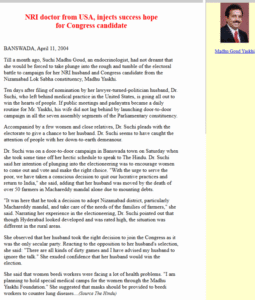 In 2004, the Congress fielded Yaskhi from the Nizamabad Lok Sabha constituency in undivided Andhra Pradesh.
He won decisively.
Yaskhi secured more than 442,000 votes, defeating his nearest rival by over 100,000 votes.
The New York lawyer was now a Member of India’s Parliament.
During his first term, he served on parliamentary bodies dealing with subordinate legislation, estimates, external affairs, civil aviation and defence-related consultation.
In 2007, Yaskhi was appointed AICC Secretary, adding a national organisational responsibility to his parliamentary career.
Five years later, Nizamabad returned him to Parliament.
Yaskhi won again in 2009, securing 296,504 votes and establishing himself as a two-term Congress MP.
His second parliamentary term also demonstrated legislative engagement. Parliamentary tracking data recorded 77 per cent attendance, 15 debates and 626 questions during the 15th Lok Sabha.
His stature within the parliamentary party grew as well.
Yaskhi served as Deputy Chief Whip of the Congress Parliamentary Party in the Lok Sabha, placing him within the party’s floor-management and parliamentary coordination structure.

But his defining political battle was unfolding elsewhere.
The Battle for Telangana
As the Telangana statehood movement intensified, Congress MPs from the region found themselves in a politically difficult position.
Their party governed India, yet pressure was mounting back home for the same government to deliver a separate Telangana.
Yaskhi emerged as one of the vocal pro-Telangana voices within the Congress.
In January 2011, amid uncertainty over the statehood process, he issued a stark warning:
“If there’s no Telangana Bill, all Cong MPs will quit.”
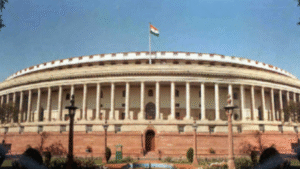
It reflected the pressure Telangana Congress parliamentarians were attempting to exert from within their own party.
In 2013, Yaskhi was appointed to the Congress Campaign Committee, adding another organisational responsibility alongside his parliamentary and Telangana-related political work.
By February 2014, the battle had reached Parliament.
Yaskhi participated in the debate surrounding the Andhra Pradesh Reorganisation legislation, which paved the way for the creation of India’s 29th state at the time.
His words in the Lok Sabha captured the emotion surrounding the movement:
“For the people of Telangana, a separate state of their own is a precious idea and a cherished goal.”
For Yaskhi, the Telangana question was not merely economic. His interventions placed emphasis on self-respect, perceived injustice and the aspiration for self-governance.
He also rejected the argument that the Congress decision was driven purely by electoral calculations.
“Politics is not the consideration to divide the state.”
The eventual formation of Telangana was, of course, much larger than any one leader or political party. It emerged from a decades-long movement involving students, employees, activists, civil society, political organisations and millions of citizens.
Yaskhi’s role belongs particularly to the parliamentary and Congress dimension of that larger struggle.
Defeats — But Not Political Disappearance
Ironically, Telangana’s creation also transformed the state’s political landscape.
In the 2014 Lok Sabha election, Yaskhi lost Nizamabad to K. Kavitha of the Telangana Rashtra Samithi.
Yet electoral defeat did not remove him from Congress politics.
 During this period, Yaskhi was entrusted with the responsibility of Congress National Spokesperson, giving him a prominent role in the party’s national communication structure.
Yaskhi continued in national and state organisational roles while remaining involved in Telangana Congress strategy.
In 2017, as an AICC Secretary, he was assigned organisational and election responsibilities in Karnataka, working with the Congress team preparing for the 2018 Karnataka Assembly elections.
During 2017–18, Yaskhi was also associated with Rahul Gandhi’s overseas outreach, including his US engagements and interactions with the Indian diaspora — a role that drew naturally on Yaskhi’s own long professional association with the United States.
He attempted a parliamentary comeback from the same Nizamabad constituency in 2019, but was unsuccessful.
As the Congress prepared for the 2023 Telangana Assembly elections, Yaskhi emerged again in a prominent organisational position as Chairman of the Telangana Congress Campaign Committee.
Yaskhi himself contested from LB Nagar in Hyderabad.
Although LB Nagar fell under Rangareddy district, the constituency was closely connected to the wider GHMC political landscape. Yaskhi entered the contest despite an unfavourable electoral environment and secured 83,273 votes — more than 80,000 votes for the Congress.
He did not win the constituency.
The Congress, however, won Telangana.
In December 2023, the party ended the BRS’s decade in power and formed its first government in the state since Telangana’s creation.
For Yaskhi, it was an organisational victory despite a personal electoral setback.
From Telangana to a National Assignment
His work subsequently extended beyond Telangana, with the Congress assigning him organisational responsibilities connected with party exercises in other states.
By then, Yaskhi’s résumé had become unusually diverse: student leader, lawyer, NRI professional, social-service organiser, two-term parliamentarian, Deputy Chief Whip, AICC Secretary, Telangana statehood advocate, national spokesperson, Karnataka organisational functionary, overseas outreach participant and state campaign chairman.
Then came September 2026.
 Congress President Mallikarjun Kharge appointed him Chairperson of the All India Professionals’ Congress, succeeding Praveen Chakravarty, who had been elected to the Rajya Sabha from Tamil Nadu.
The appointment carries an obvious symbolism.
A man who spent a significant part of his early career outside conventional politics — studying law, practising professionally and working overseas — now leads the Congress platform intended to connect professionals, entrepreneurs, specialists and knowledge-sector workers with political and public life.
In that sense, the assignment is not simply another party designation.
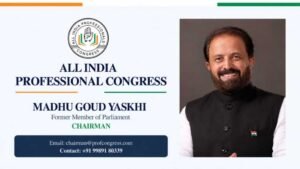
It reconnects Yaskhi’s politics with his professional beginnings.
A Journey Without a Conventional Ladder
There has never been a perfectly straight line through Madhu Goud Yaskhi’s career.
His journey did not follow the familiar progression of student-wing office-bearer, Youth Congress leader and then elected representative.
Instead, it moved from student leadership in Hyderabad to law classrooms in Delhi, from a professional career in New York back to Telangana, from social service to Parliament, and from Parliament into the struggle for statehood.
There were major victories — two consecutive terms in the Lok Sabha.
There were significant setbacks — repeated electoral defeats after 2009.
And there were political reinventions — parliamentarian, AICC Secretary, national spokesperson, Karnataka organisational functionary, overseas outreach participant, campaign strategist and national party functionary.
Through much of that journey ran one constant thread: Telangana.
More than a decade after his last term in Parliament, Yaskhi has now returned to a prominent national organisational role.
From a student leader in Hyderabad to a lawyer in New York, from Nizamabad to the Lok Sabha, from the battle for Telangana to the leadership of the All India Professionals’ Congress, Madhu Goud Yaskhi’s journey has been less about a straight political ascent and more about repeatedly finding a new arena in which to remain relevant.

His latest chapter has only just begun.
