
By State bureau
AIPC Chairman proposes district-level MSME clinics, 1,000 documented assistance cases and a policy white paper; parliamentarians, British representatives and industry experts discuss economic growth, trade agreements and professional leadership.
CHENNAI | November 22, 2026
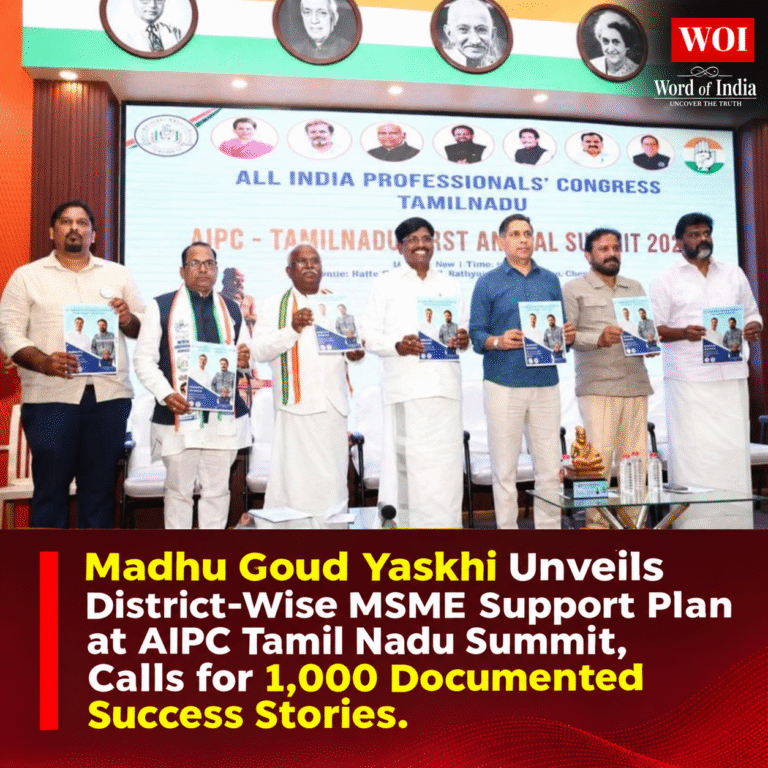
All India Professionals’ Congress (AIPC) National Chairman and former Lok Sabha MP Madhu Goud Yaskhi unveiled a comprehensive roadmap for MSME development, economic reforms and professional participation in governance at the first annual AIPC Tamil Nadu Summit, held at Sathyamurthy Bhavan in Chennai on November 21.
The summit brought together Tamil Nadu Higher Education Minister P.Viswanathan, Rajya Sabha MPs Praveen Chakravarty and Christopher Tilak, Lok Sabha MP C. Robert Bruce, keynote speaker Pramod Reddy, British diplomatic representatives, education specialists and AIPC leaders from across India.
 Madhu Goud Yaskhi Calls for Statewide MSME Support
 Madhu Goud Yaskhi Calls for Statewide MSME Support
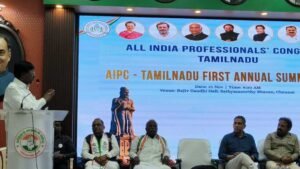
Delivering the principal address, Yaskhi proposed establishing AIPC MSME clinics in every district of Tamil Nadu, where chartered accountants, lawyers and engineers would volunteer one Saturday every month to assist small enterprises with taxation, registrations, loan applications, legal matters and delayed-payment recovery.
He set a target of 1,000 documented MSME assistance outcomes before the proposed second annual summit in November 2027, including recovered payments, sanctioned loans, resolved electricity-billing issues and completed registrations.
Yaskhi also proposed submitting a policy white paper on delayed MSME payments to the Tamil Nadu government ahead of its next budget.
Highlighting financial distress, he claimed that outstanding MSME payments nationwide exceeded ₹7 lakh crore and questioned delays beyond the statutory 45-day payment framework. He criticised unequal borrowing costs and urged greater accountability from public sector undertakings and wider adoption of the Trade Receivables Discounting System (TReDS).
He proposed technology cooperation between turmeric farmers and processing enterprises in Nizamabad and Erode, alongside expanding the Dr. Manmohan Singh Fellowship to 100 fellows.
Criticising demonetisation, Yaskhi emphasised the importance of professional economic expertise in policymaking. Paying tribute to K. Kamaraj, he recalled Tamil Nadu’s educational and industrial achievements, including school meal programmes and the Guindy and Ambattur industrial estates.
He also highlighted women’s participation in manufacturing, industrial productivity, social justice and Rahul Gandhi’s emphasis on the caste census.
Outlining AIPC’s organisational roadmap, Yaskhi proposed concentrating on 100 districts covering approximately 150 parliamentary constituencies ahead of the 2029 general elections and announced the resumption of membership enrolment.
Minister Viswanathan Announces Higher Education Reforms
Tamil Nadu Higher Education Minister P. Viswanathan announced that the Governor had granted assent to the Tamil Nadu Private Universities Laws (Amendment) Bill, 2026.
The amendment reduces minimum land requirements for establishing private universities to 12 acres in Greater Chennai, 18 acres in other municipal areas and 25 acres elsewhere, while lowering the permanent endowment requirement from ₹50 crore to ₹25 crore.
The Minister said implementation guidelines would be prepared to encourage international-standard educational institutions, research facilities and academic infrastructure within Tamil Nadu.
He also praised Yaskhi’s leadership, recalled their association during the Telangana statehood movement and encouraged AIPC to organise a national conclave in Tamil Nadu.
Praveen Chakravarty Emphasises Professional Political Leadership
Rajya Sabha MP and immediate past AIPC Chairman Praveen Chakravarty recalled Rahul Gandhi’s vision of transforming professionals into political leaders rather than merely recruiting politicians into professional organisations.
Highlighting the historical contributions of professionals to Congress and Dr. Manmohan Singh’s economic leadership, he stressed the importance of specialised professional verticals.
Referring to Congress’s performance in metropolitan constituencies during the 2009 elections, he called for stronger urban professional engagement ahead of 2029.
He also encouraged AIPC chapters to promote successful state initiatives such as StartupTN nationally.
Robert Bruce Questions Make in India Outcomes
Lok Sabha MP C. Robert Bruce questioned the implementation of the Union government’s Make in India initiative, particularly in the medical devices sector.
Referring to parliamentary committee discussions, he claimed that domestic medical-device manufacturing remained heavily dependent on imports despite government initiatives.
Bruce urged professionals to examine industrial policies through measurable outcomes and assured participants that he would raise MSME and manufacturing concerns in Parliament.
Christopher Tilak Proposes Monthly Professional Consultations
Rajya Sabha MP Christopher Tilak proposed conducting monthly full-day consultations involving professional communities and relevant government ministers, covering approximately 10–12 sectors annually.
He also encouraged AIPC members to apply their expertise in technology, management and data analysis to modernise political organisations.
Drawing on his engineering, management and export-industry experience, he emphasised combining professional knowledge with grassroots political understanding.
Pramod Reddy Calls for Strategic Trade Policies and MSME-Led Growth
Keynote speaker Pramod Reddy emphasised that India’s economic progress requires a stronger connection between international trade agreements, domestic manufacturing capabilities and MSME competitiveness.
He argued that trade agreements should be assessed not merely by the markets they open, but by their ability to strengthen Indian enterprises, encourage technology transfer, generate employment and create sustainable economic value.
Calling for a forward-looking economic framework, he highlighted the importance of enabling MSMEs to participate in global supply chains and ensuring that international trade opportunities translate into tangible benefits for domestic industries.
Sudhakar Sundaravel Unveils Vision 2030 Roadmap
Sudhakar Sundaravel, AIPC Tamil Nadu State Interim President and National Head of the MSME Vertical, described AIPC as Rahul Gandhi’s initiative to connect doctors, engineers, entrepreneurs, lawyers, academicians and other professionals with public policy.
Highlighting AIPC’s 14 specialised professional verticals, he emphasised documenting sector-specific problems and presenting recommendations to elected representatives.
He unveiled AIPC Tamil Nadu’s Vision 2030 roadmap, covering education, industry and trade, and honoured immediate past Chairman Praveen Chakravarty with the title “Modern Political Architect.”
Shashank Pasupuleti, AIPC Telangana State MSME Head, endorsed National Chairman Madhu Goud Yaskhi’s economic observations, stating that India needs genuine economists with proven expertise, like former Prime Minister Dr. Manmohan Singh, rather than individuals merely acting as economists. He emphasised that professionals working together as one community could become a powerful force in accelerating India’s economic growth.
British Deputy High Commissioner Highlights UK–India Trade
Sutapa Choudhury, British Deputy High Commissioner for Tamil Nadu and Kerala, highlighted opportunities arising from the UK–India Comprehensive Economic and Trade Agreement, signed in July 2025.
She cited tariff liberalisation covering approximately 99% of UK tariff lines and 90% of Indian tariff lines, benefiting sectors including textiles, footwear, engineering and services.
Referring to bilateral trade of approximately £48 billion and projected long-term growth of £25.5 billion, she discussed investment, digital trade, customs cooperation and professional mobility.
She encouraged Tamil Nadu businesses to explore UK market opportunities and welcomed expanding higher education partnerships.
British Council Highlights Future-Ready Education
Janaka Pushpanathan, Director at the British Council, emphasised education and workforce development under the UK–India Vision 2035 framework.
Citing projections that nearly 40% of workforce skills could change in the coming years, she highlighted the importance of critical thinking, technological adaptability and international collaboration.
She praised Tamil Nadu’s higher education gross enrolment ratio exceeding 50% and referred to more than 140 UK–India academic partnerships.
She also highlighted British university initiatives in Bengaluru and the proposed University of East London career development hub in Chennai in 2027, alongside Tamil Nadu’s StartupTN ecosystem.
Anand Srinivasan Recalls AIPC’s Growth
TNCC Media and Publicity Department Chairperson Anand Srinivasan recalled AIPC Tamil Nadu’s establishment in 2017, when its first Abiramapuram meeting attracted approximately 300 professionals, followed by a gathering of nearly 900 participants in Guindy during founding Chairman Shashi Tharoor’s visit.
He highlighted statewide membership expansion, manifesto consultations, policy research on Tiruppur’s garment industry and cooperation between Tamil Nadu and Kerala AIPC chapters.
He described AIPC as an important platform enabling professionals to enter mainstream political leadership.
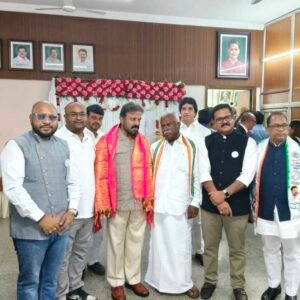
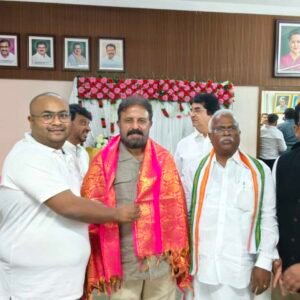
 AIPC Leaders from Across India Participate
 AIPC Leaders from Across India Participate
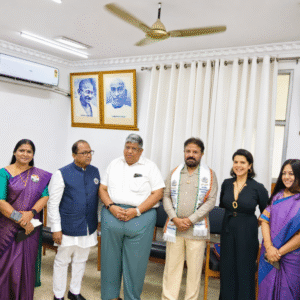
The summit also witnessed participation from Kerala AIPC State President Ranjith Balan, Jharkhand representative Katia Munjal, Telangana State MSME Head Shashank Pasupuleti, Telangana representative Delhi Jahidul , Arunkarunanithi and AIPC office-bearers and members from various states.
Their participation highlighted the organisation’s nationwide professional network and opportunities for coordination among state chapters.
The summit concluded with a call to translate professional expertise into measurable MSME assistance, evidence-based policymaking, educational advancement and stronger economic cooperation, positioning the proposed Tamil Nadu initiatives as a potential model for other AIPC chapters.
