
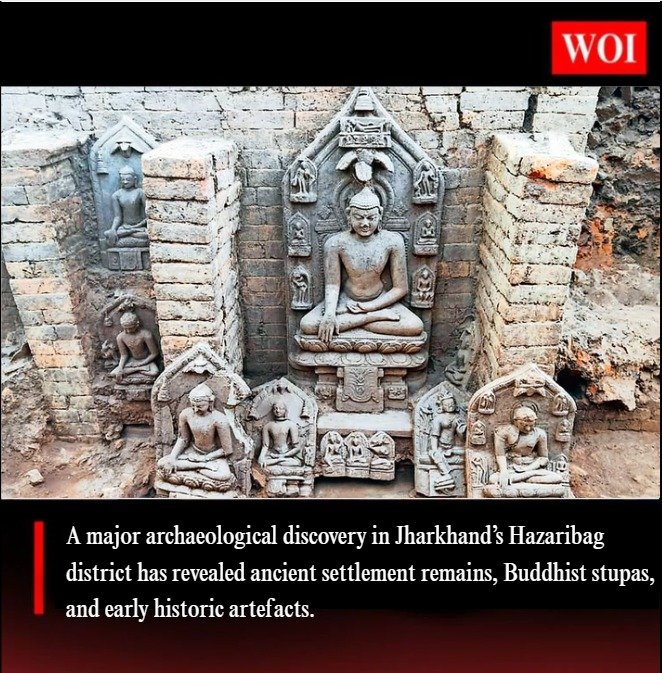
An archaeological site in the Chauparan block of Hazaribag district in Jharkhand has revealed evidence of a layered ancient settlement in the Mohane river basin. The discoveries were made across villages including Dehar, Sohra, Mangarh, and Hathinder, where artefacts were unearthed during farming activities and foundation digging.
Researchers believe the settlement dates back nearly 3,200 years and contains remains from multiple historical periods. The site includes habitation layers, debris zones, and buried structures, indicating long-term human occupation and cultural continuity in the region.
Teams from Indian Institute of Technology (Indian School of Mines) Dhanbad and Visva-Bharati University used Ground Penetrating Radar (GPR) surveys to study the area. The surveys identified large underground structures measuring more than 100 feet in length, suggesting the presence of major ancient constructions beneath the surface.
Among the important findings are samples of Northern Black Polished Ware (NBPW), a distinctive black-glazed pottery associated with the early historic period in the Indian subcontinent. Archaeologists have also recovered statues of Gautam Buddha, Tara, Marichi, Avalokiteshvara, Brahma, Vishnu, Mahesh, and Ganesha, reflecting the coexistence of Buddhist and Hindu traditions across different periods.
A large mound in Mangarh village has been identified as a possible ancient Buddhist stupa dating back around 2,500 to 3,000 years. Historians and conservation experts have urged the Archaeological Survey of India to intervene and provide official protection to preserve the site’s historical and cultural significance.
The findings highlight the rich archaeological heritage of Hazaribag and strengthen evidence of ancient settlements and religious activity in eastern India.
