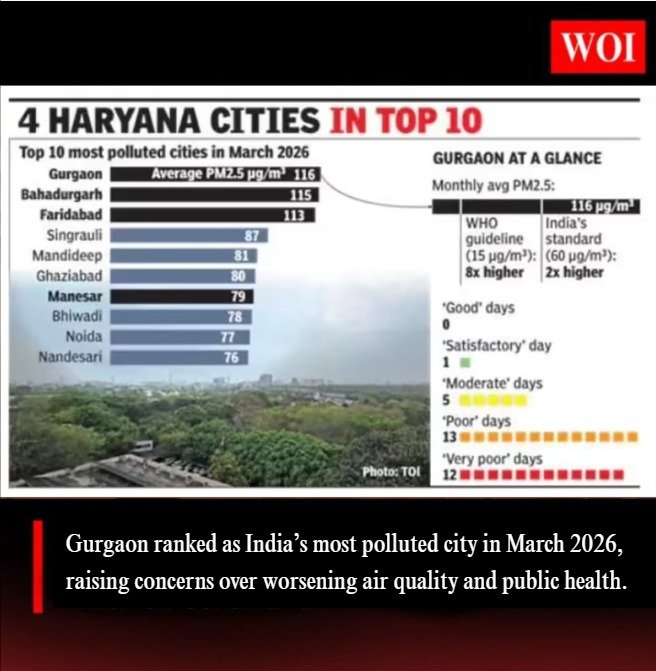
A recent report by the Centre for Research on Energy and Clean Air has identified Gurgaon as the most polluted city in India for March 2026, highlighting worsening air quality and rising health concerns across urban regions. The city recorded an average PM2.5 level of 116 µg/m³, far exceeding safe limits and posing serious risks, especially to children and the elderly.
The report also revealed that Haryana dominates the list of the most polluted cities, with places like Bahadurgarh, Faridabad, and Manesar joining Gurgaon in the top rankings. Other cities across states such as Uttar Pradesh, Madhya Pradesh, Rajasthan, and Gujarat also featured among the worst-affected, indicating that air pollution is a widespread national issue.
While Gurgaon topped the March rankings, Ghaziabad emerged as the most polluted city for the entire financial year 2025–26, reflecting the long-term nature of the problem. A significant number of cities continue to fail in meeting the National Ambient Air Quality Standards (NAAQS), with Haryana and Uttar Pradesh reporting the highest violations.
India’s National Clean Air Programme (NCAP), launched to curb pollution, has shown mixed results. Although some cities have achieved notable reductions in pollution levels, others have experienced worsening conditions. For instance, Dehradun recorded a major improvement, while cities like Visakhapatnam saw a sharp rise in pollution.
Experts emphasise the need for stronger, region-specific strategies, stricter enforcement of emission norms, and expansion of clean air initiatives. The report underscores that tackling air pollution requires sustained efforts, scientific planning, and coordinated action at both state and national levels.
