
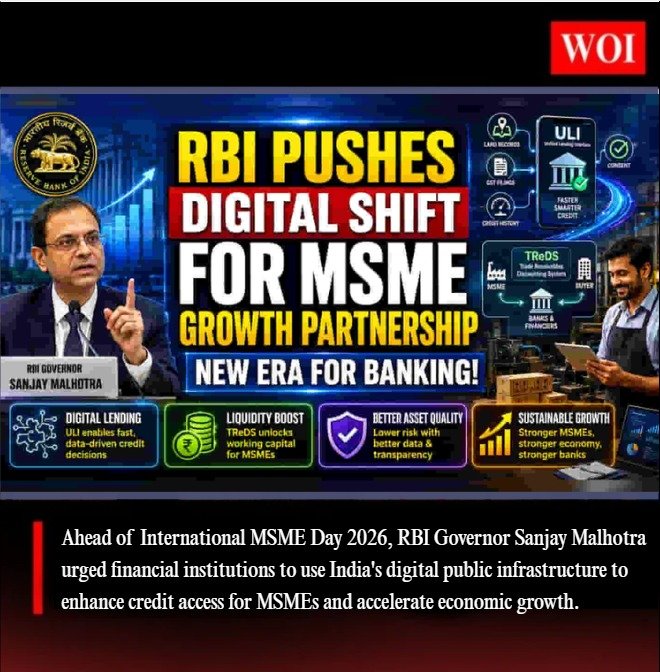
The Reserve Bank of India (RBI) has called upon banks and non-banking financial companies (NBFCs) to make greater use of India’s Digital Public Infrastructure (DPI) to expand credit access for Micro, Small, and Medium Enterprises (MSMEs). RBI Governor Sanjay Malhotra emphasized the importance of digital lending solutions while addressing stakeholders in Kochi ahead of International MSME Day 2026.
India’s digital financial ecosystem, including the Account Aggregator (AA) framework, Unified Lending Interface (ULI), Trade Receivables Discounting System (TReDS), GST data trails, and Aadhaar-enabled authentication, is playing a crucial role in improving credit delivery to small businesses. These platforms enable faster, transparent, and data-driven lending decisions, helping MSMEs access formal credit with greater ease.
The Account Aggregator framework, a consent-based financial data-sharing system, facilitated lending worth ₹3.5 trillion during FY26, demonstrating its growing role in digital finance. Similarly, ULI and TReDS are streamlining credit access and invoice financing, particularly for small enterprises.
According to RBI data, outstanding bank credit to the MSME sector reached ₹36.79 trillion as of December 31, 2025. The central bank has also urged lenders to strengthen the implementation of government-backed initiatives such as Priority Sector Lending (PSL), MUDRA, PM-SVANidhi, PM Vishwakarma, and Credit Guarantee Schemes for Micro and Small Enterprises.
MSMEs are a vital pillar of India’s economy, contributing significantly to employment generation, manufacturing output, and exports. By leveraging digital public infrastructure, the RBI aims to improve financial inclusion, enhance credit flow, and support the growth of millions of small businesses across the country.
