
By Soniya:
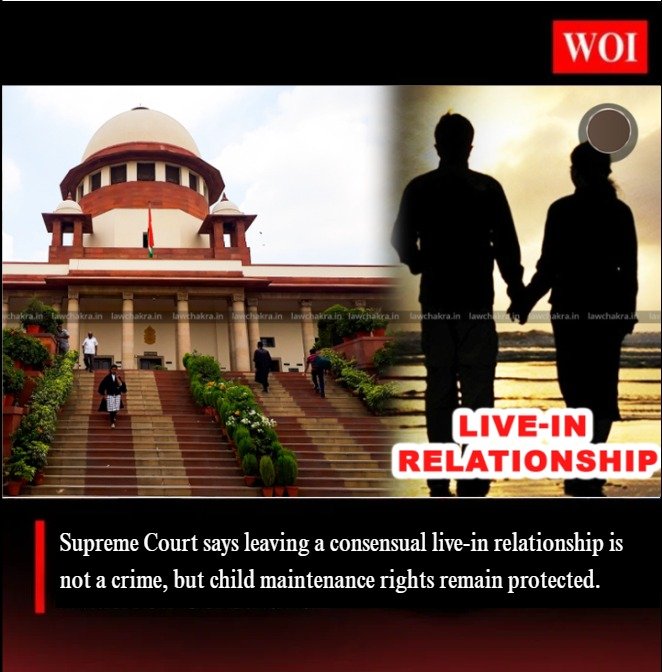
The Supreme Court of India has reaffirmed that exiting a consensual live-in relationship does not constitute a criminal offence, while also elaborating on the constitutional and legal framework governing such relationships in India.
A Bench of Justices B V Nagarathna and Ujjal Bhuyan held that emotional distress or the breakdown of a relationship cannot retrospectively convert a consensual arrangement into a criminal case. The court emphasized that criminal charges such as sexual assault or exploitation require absence of consent or coercion, and cannot be invoked merely because one partner chooses to leave the relationship.
Constitutional Perspective
The judgment draws strength from Article 21 of the Constitution of India, which guarantees the right to life and personal liberty. Over the years, the Supreme Court has interpreted Article 21 to include the freedom to choose one’s partner and cohabit without interference, recognizing live-in relationships as part of individual autonomy and dignity.
Additionally, the court has previously linked such choices to Article 19 of the Constitution of India, particularly the freedom of expression and lifestyle choices, reinforcing that consenting adults have the right to live together without societal or state interference.
Legal Framework Governing Live-in Relationships
While live-in relationships are not legally equivalent to marriage, Indian law provides certain protections:
- Under the Protection of Women from Domestic Violence Act, 2005, women in relationships “in the nature of marriage” can seek protection against abuse, residence rights, and maintenance.
- Section 125 of the Code of Criminal Procedure, 1973 allows children (and in some cases women) to claim maintenance, ensuring financial support.
- Courts have also recognized the legitimacy and rights of children born from such relationships, ensuring they are not discriminated against.
Key Observations by the Court
The Bench clarified that:
- A consensual live-in relationship does not create a legally binding obligation like marriage.
- Withdrawal from such a relationship is a personal decision, not a criminal act.
- Criminal law cannot be used to address emotional grievances unless there is clear evidence of fraud, coercion, or lack of consent.
Protection of Child Rights
Importantly, the court upheld that the rights of the child remain unaffected. The woman was granted the liberty to seek maintenance for her child, reaffirming that children born out of live-in relationships are entitled to legal protection and financial support.
Broader Implications
This ruling reinforces the distinction between civil liability and criminal offence. While live-in relationships may give rise to civil remedies such as maintenance or protection under specific laws, they do not automatically attract criminal liability.
The judgment also highlights the evolving nature of Indian constitutional law, where personal relationships are increasingly viewed through the lens of individual liberty, dignity, and consent rather than moral considerations.
