
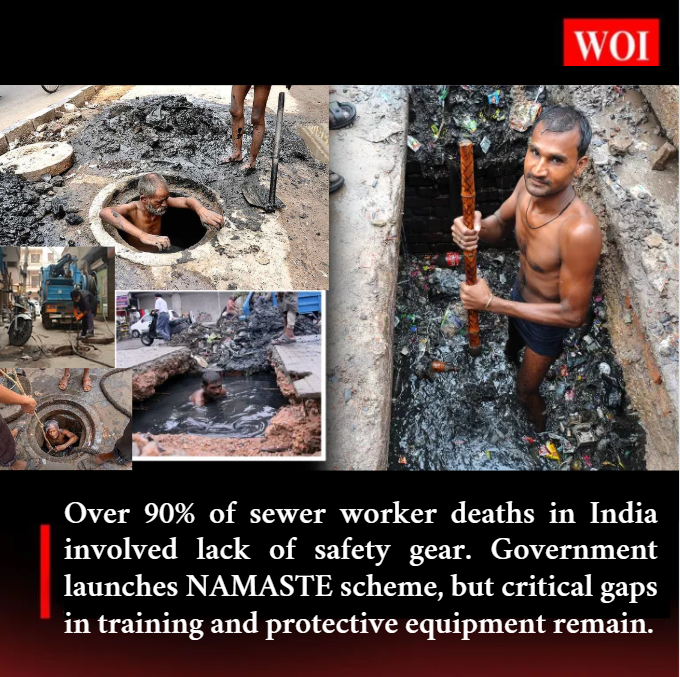
Recent reports have spotlighted critical safety failures in India’s sewer and septic tank cleaning operations. A social audit commissioned by the government found that over 90% of sanitation workers who died during hazardous cleaning between 2022 and 2023 lacked access to essential protective equipment.
The audit studied 54 fatal cases across eight States and Union Territories. It revealed that in 49 of these, workers had no access to even basic gear such as gloves, masks, or hazmat suits. Mechanised cleaning—considered a safer alternative—was almost never used, and safety training was virtually nonexistent.
Disturbingly, in half the cases reviewed, workers were not even asked for consent before undertaking dangerous tasks. Even when written consent was obtained, workers were not informed about the inherent risks. Most were hired individually or via contractors, a system that often bypasses standard government safety protocols.
In response to these findings, the Ministry of Social Justice and Empowerment launched the NAMASTE scheme in July 2023. The programme aims to identify and protect nearly 85,000 sanitation workers across the country. So far, about 50% have received PPE kits. Odisha stands out as the only state to ensure complete PPE coverage, thanks to its Garima scheme.
Workshops on hazardous cleaning prevention have reached approximately 1,000 workers, but awareness campaigns post-fatalities remain limited. Equipment shortages and the absence of emergency response systems continue to threaten worker safety.
Despite over ₹20 crore allocated under the NAMASTE scheme, sanitation workers in India continue to face life-threatening conditions, underscoring the need for urgent reforms and accountability mechanisms.
