By Priyanka Pasupuleti:
In a major step towards cleaner cities and sustainable living, India has notified the Solid Waste Management Rules, 2026, which will come into force from 1 April 2026, replacing the earlier 2016 framework. The rules were issued on 27 January 2026 by the Ministry of Environment, Forest and Climate Change (MoEFCC) and aim to strengthen waste segregation, promote a circular economy, and enhance accountability across the waste management chain.
Key Changes Under the 2026 Rules
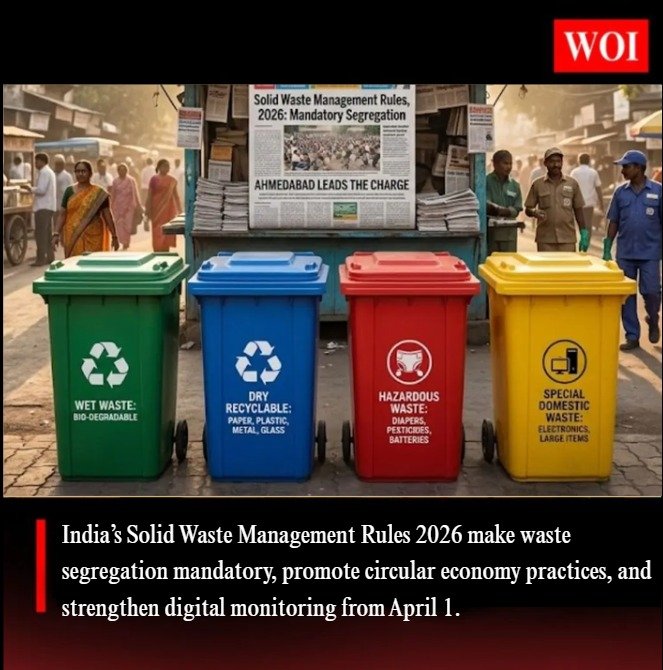
A major reform introduced is mandatory four-stream segregation at source. Households, institutions, and commercial establishments must now segregate waste into wet (biodegradable), dry (recyclable), sanitary, and special-care waste. This is expected to significantly improve recycling rates and reduce pressure on landfills.
Circular Economy and Shared Responsibility
The new rules place strong emphasis on a circular economy, encouraging reuse, recycling, and recovery of waste. A key provision is the introduction of Extended Bulk Waste Generator Responsibility (EBWGR), under which bulk waste generators such as hotels, large institutions, and residential complexes must ensure proper segregation, collection, processing, and environmentally sound disposal of waste.
Digital Monitoring and Transparency
To improve compliance and efficiency, the government has introduced a centralised online portal for digital tracking of waste. All stages—from collection and transportation to processing and disposal—will be monitored in real time, enabling authorities to identify gaps and enforce accountability.
Industry and Energy Transition
Industries, particularly cement plants and waste-to-energy facilities, have been directed to increase the use of Refuse Derived Fuel (RDF). The fuel substitution target has been raised from 5% to 15% over the next six years, reducing dependence on fossil fuels and supporting cleaner energy alternatives.
Role of Local Bodies
The rules clearly define responsibilities for urban and rural local bodies, as well as state and Union Territory governments. They also introduce graded and faster land allocation norms for waste processing facilities to accelerate infrastructure development.
Overall, the Solid Waste Management Rules 2026 mark a significant shift towards scientific, transparent, and sustainable waste management, aligning environmental protection with India’s broader climate and development goals.
