
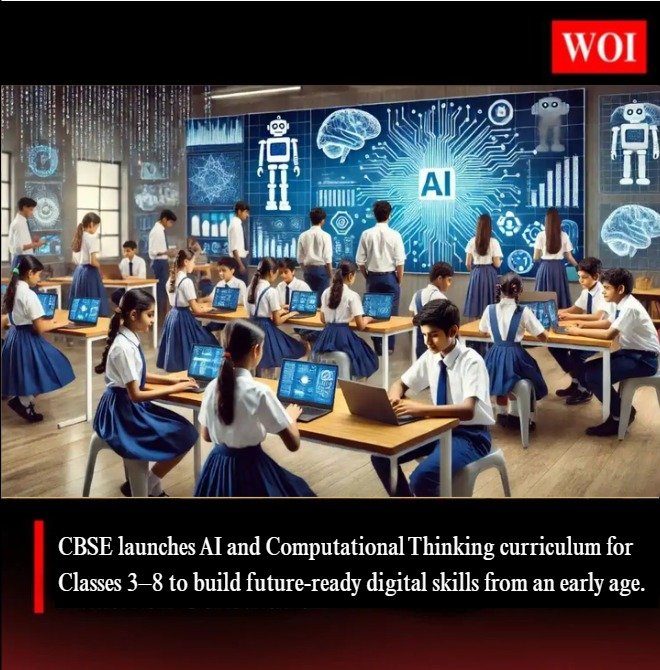
In a major step towards future-ready education, the Central Board of Secondary Education (CBSE) has launched a new Computational Thinking (CT) and Artificial Intelligence (AI) curriculum for students of Classes 3 to 8. The curriculum was formally unveiled on 2 April 2026 at Vigyan Bhawan, New Delhi, by Union Minister for Education Dharmendra Pradhan.
Building Future-Ready Learners
The initiative aims to introduce structured AI education at an early stage, helping young learners develop essential digital-age skills such as logical thinking, problem-solving, pattern recognition, and responsible use of technology. The curriculum will be implemented from the 2026–27 academic year and is supported by teacher handbooks, student modules, and assessment frameworks.
Aligned With National Education Vision
The curriculum aligns with the National Education Policy 2020 and the National Curriculum Framework 2023, reinforcing India’s goal of becoming a global leader in AI and emerging technologies.
Activity-Based Learning Approach
Students will learn through games, puzzles, worksheets, and hands-on activities, encouraging experiential and collaborative learning. Teachers will guide learners to break complex problems into simpler steps and interpret visual data such as charts and diagrams.
Why Computational Thinking Matters
Computational Thinking is a foundational skill used in coding, artificial intelligence, and data analysis. Introducing CT early helps students build strong reasoning abilities and prepares them for technology-driven careers.
Overall, this CBSE initiative marks a transformative shift in school education, embedding AI and computational thinking into classrooms and equipping India’s young minds for the digital future.
