
By Soniya:
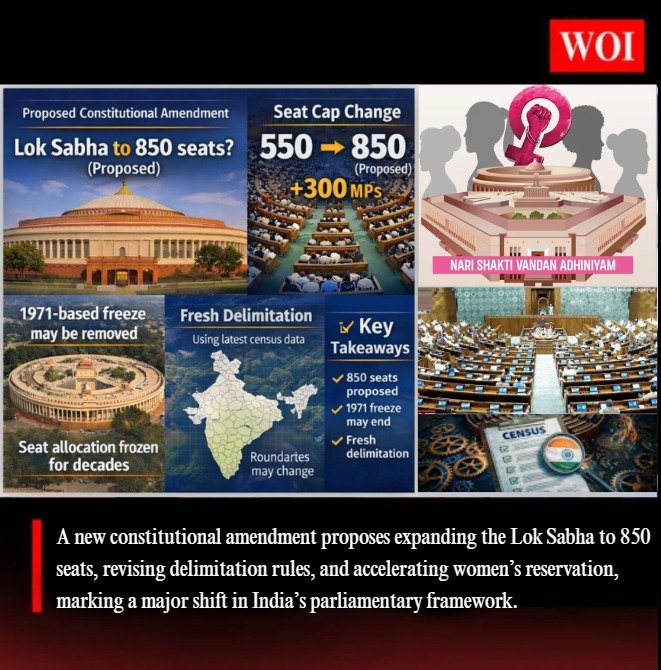
The Union government has proposed a major constitutional reform that could significantly alter India’s parliamentary structure by expanding the strength of the Lok Sabha and revising long-standing delimitation rules. Introduced as the Constitution (One Hundred and Thirty First Amendment) Bill, 2026, the proposal seeks to increase Lok Sabha seats from 543 to 850 and allow earlier redistribution of constituencies without waiting for the post-2026 Census.
A key shift in the amendment is the removal of the mandatory link between delimitation and the first Census after 2026. This would enable constituency redrawing based on existing census data, paving the way for faster implementation of 33% women’s reservation in Parliament and State Assemblies, as provided under the 106th Constitutional Amendment.
The proposed expansion reflects India’s growing population and aims to ensure fairer representation, as current seat allocations are still largely based on the 1971 Census. The accompanying Delimitation Bill, 2026, would replace the Delimitation Act of 2002 and empower a Delimitation Commission—headed by a Supreme Court judge—to redraw boundaries, allocate seats, and revise reservations for SCs, STs, and women.
If passed, the amendment could mark one of the most consequential reforms in India’s democratic framework, impacting representation, gender inclusion, and the balance of political power among states.
