
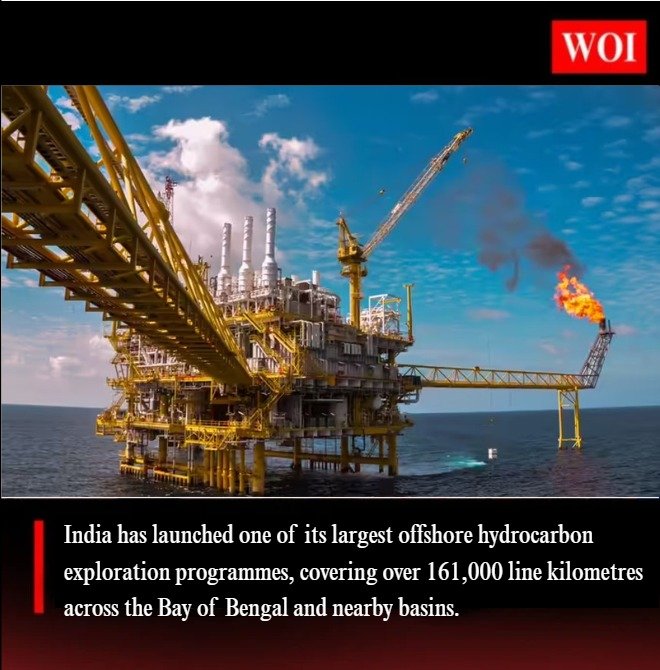
India is rapidly expanding its offshore oil and gas exploration activities across the Bay of Bengal and adjoining sedimentary basins as part of a major push to strengthen long-term energy security. The Directorate General of Hydrocarbons (DGH) is currently leading one of India’s largest offshore seismic survey programmes, covering nearly 161,000 line kilometres over two years.
The exploration effort includes key offshore basins such as the Bengal Basin, Krishna-Godavari Basin, Cauvery Basin, Mahanadi Basin, Saurashtra Basin, and the strategically important Andaman Basin. These regions are believed to contain significant untapped hydrocarbon reserves in both shallow and deepwater zones.
As part of the programme, ONGC and Oil India are preparing for stratigraphic drilling operations in 2026 to gather geological data and identify future production potential. The first phase will include deep-sea wells in the Andaman, Mahanadi, Bengal, and Saurashtra basins.
India has also expanded exploration opportunities under the Hydrocarbon Exploration and Licensing Policy (HELP) and the Open Acreage Licensing Programme (OALP). The government earlier opened nearly one million square kilometres of previously restricted offshore “No-Go” areas for energy exploration.
Officials believe the initiative could reduce India’s dependence on imported crude oil while boosting domestic production, investment, and technological advancement in the offshore energy sector.
