
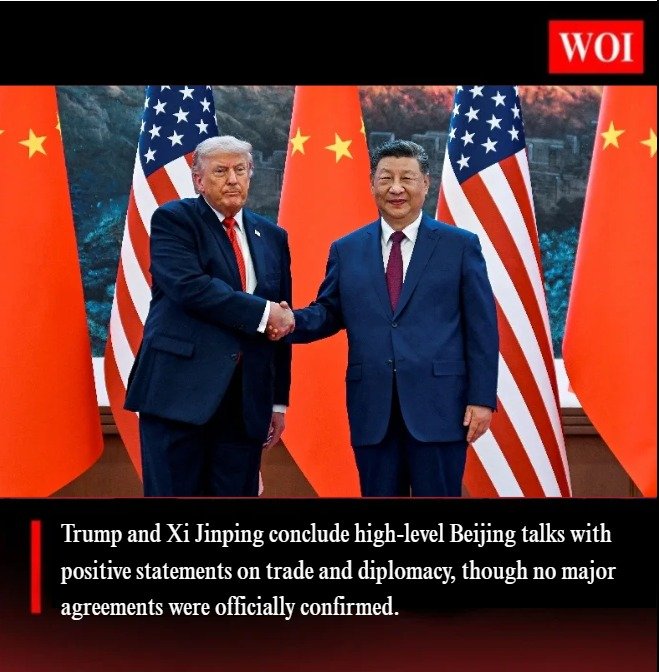
US President Donald Trump and Chinese President Xi Jinping recently concluded high-level talks in Beijing, with both leaders describing the discussions as constructive and successful. While the summit generated global attention and diplomatic symbolism, no major confirmed agreements were officially announced.
During the meeting, Trump reportedly called the talks “fantastic” and mutually beneficial, while Xi described the visit as “historic” and important for future cooperation between the world’s two largest economies. Trump also extended an invitation for Xi Jinping to visit the White House in the coming months.
One of the major areas of discussion was trade and economic cooperation. Trump claimed that China could potentially purchase nearly 200 Boeing aircraft along with billions of dollars worth of American agricultural products. However, Chinese authorities have not yet officially confirmed these announcements, leaving uncertainty about the actual scope of the proposed deals.
The talks also focused on broader issues including artificial intelligence, global trade stability, technology cooperation, and ongoing geopolitical tensions. Despite expectations of progress on tariffs, Trump stated that direct tariff negotiations were not the central focus of the meeting. Instead, both sides appeared to emphasize maintaining long-term economic stability and avoiding further escalation in trade tensions.
Analysts believe the summit was more about rebuilding communication and reducing uncertainty rather than securing immediate breakthrough agreements. With global markets closely watching US-China relations, even limited diplomatic stability between Washington and Beijing is being viewed as significant for international trade and economic confidence.
