
By Soniya:
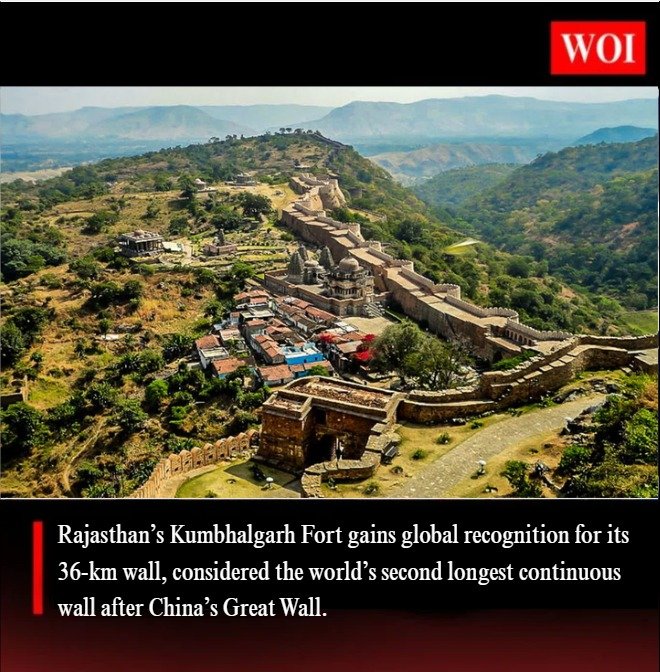
Kumbhalgarh Fort, often called the “Great Wall of India,” has received global recognition after a UNESCO survey identified its 36-kilometre defensive wall as the world’s second longest continuous intact wall after the Great Wall of China. Located in the Aravalli Hills of Rajasthan, the fort is one of India’s finest examples of Rajput military architecture and engineering.
The fort was constructed during the 15th century by Rana Kumbha, the ruler of Mewar, with architect Mandan leading its design. Built across difficult mountainous terrain, the fort was strategically planned to provide strong defense and resilience against invasions. Its massive wall, stretching across forests, valleys, and hills, is between 15 and 25 feet wide and is traditionally said to be broad enough for eight horses to ride together.
Kumbhalgarh Fort is also part of the UNESCO World Heritage Site group known as the Hill Forts of Rajasthan, which received recognition in 2013. The group includes forts such as Chittorgarh, Amber, Jaisalmer, Ranthambore, and Gagron, all known for their cultural and architectural importance.
The fort complex contains more than 360 temples, including Jain and Hindu shrines, highlighting its role as a self-sustained fortified settlement. One of its major attractions is the Badal Mahal, situated at the highest point of the fort and known for panoramic views of the surrounding landscape.
Kumbhalgarh also holds historical significance as the birthplace of Maharana Pratap, one of the most celebrated Rajput warriors in Indian history. The fort continues to stand as a symbol of Rajasthan’s heritage, military strength, and architectural brilliance.
