
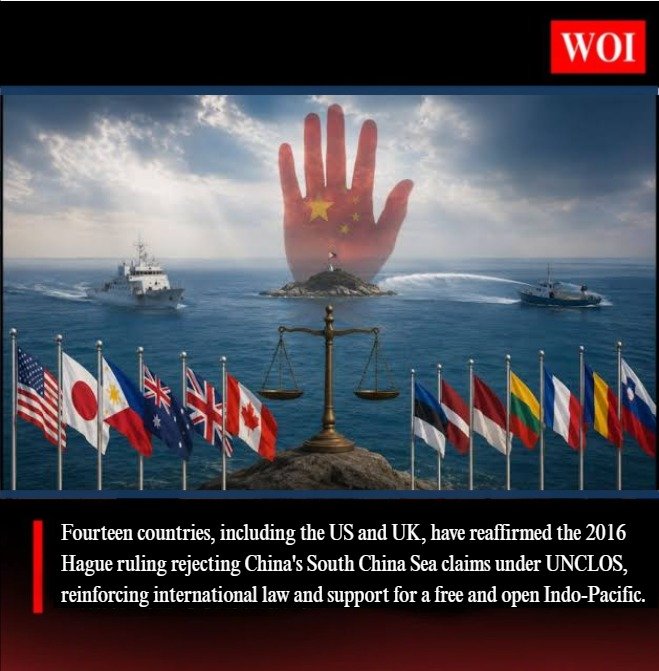
The United States, United Kingdom, and 12 other countries have reaffirmed that China’s expansive claims in the South China Sea have no legal basis under international law, marking the 10th anniversary of the landmark 2016 Hague Arbitration ruling. The joint statement described the arbitral award under the United Nations Convention on the Law of the Sea (UNCLOS) as final and legally binding, while urging all parties to resolve disputes peacefully.
The statement was issued by the United States, United Kingdom, Philippines, Japan, Australia, New Zealand, Canada, Germany, Italy, Estonia, Latvia, Lithuania, Romania, and Slovenia. The countries reiterated that China’s claims based on the “Nine-Dash Line” and alleged historic rights are inconsistent with UNCLOS. The European Union also endorsed the ruling, calling it a landmark decision for the peaceful settlement of maritime disputes.
The arbitration case was initiated by the Philippines in 2013, following tensions over disputed features such as Scarborough Shoal. On 12 July 2016, the Permanent Court of Arbitration in The Hague ruled overwhelmingly in favor of the Philippines, concluding that China’s historic rights claims had no legal basis and that several disputed maritime features were not entitled to extensive maritime zones.
China has continued to reject the ruling, calling it “null and void”, refusing to participate in the arbitration process, and insisting that the tribunal lacked jurisdiction. Beijing also maintains that it will not accept third-party dispute settlement over the South China Sea.
The joint declaration expressed concern over the increasing use of coast guard vessels, maritime militia, military ships, water cannons, and aggressive maneuvers in disputed waters, warning that such actions threaten regional peace, freedom of navigation, and international trade. The South China Sea is one of the world’s busiest maritime routes, carrying trillions of dollars in global trade annually while containing rich fishing grounds and significant oil and natural gas reserves.
The United States also reaffirmed that the 1951 US–Philippines Mutual Defense Treaty remains applicable if Philippine armed forces, public vessels, or aircraft come under armed attack in the South China Sea. The joint statement highlights growing international support for a rules-based Indo-Pacific, emphasizing that maritime disputes should be resolved through international law, diplomacy, and peaceful dialogue rather than coercion or unilateral actions.
