
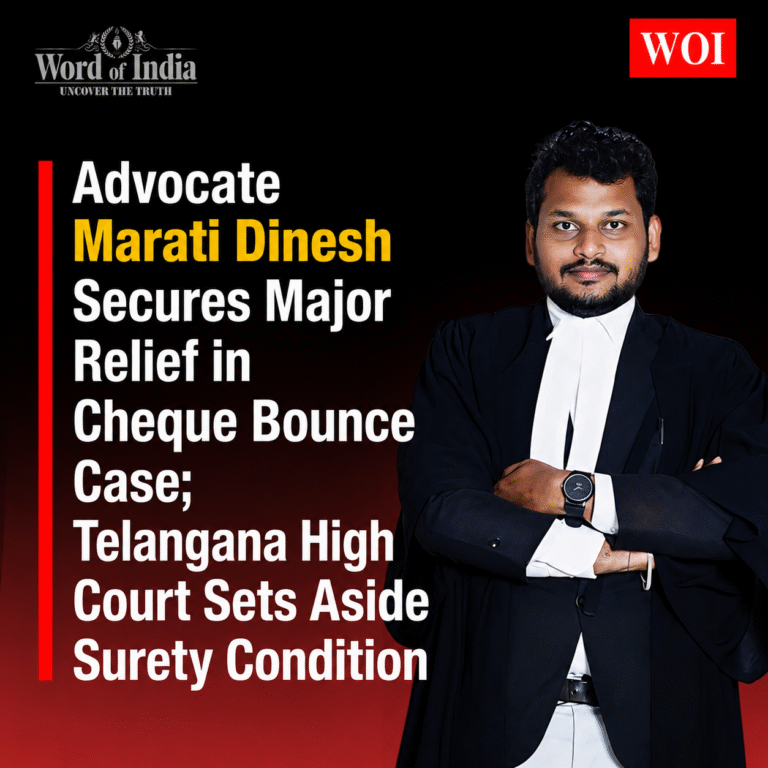
By Shashank Pasupuleti
Personal Bond Enough in Section 138 NI Act Cases; Courts Must Avoid Procedural Harassment, Rules High Court
Hyderabad :
In a significant judgment reinforcing procedural fairness in cheque bounce litigation, the Telangana High Court has held that trial courts should not mechanically insist upon external sureties from accused persons in routine cases filed under Section 138 of the Negotiable Instruments (NI) Act. The Court observed that a reasonable personal bond is sufficient to secure the attendance of an accused in such proceedings and cautioned against imposing unnecessary hardships in private complaint cases.
The ruling came in a Criminal Petition challenging an order passed by the Special Magistrate Court at Bhongir, which had directed an accused to execute a personal bond of ₹10,000 and furnish two local sureties for an equivalent amount.
According to court records, the accused had been regularly appearing before the trial court and actively participating in the proceedings. However, despite his consistent attendance, the Magistrate repeatedly insisted on the production of sureties and allegedly warned that a Non-Bailable Warrant (NBW) could be issued if the conditions were not complied with immediately.
Aggrieved by what was described as an excessive and coercive approach, the petitioner approached the Telangana High Court seeking intervention.

Appearing for the petitioner, Advocate Marati Dinesh argued that offences under Section 138 of the NI Act arise out of private financial disputes and are quasi-criminal in nature. He contended that demanding multiple local sureties at the initial stage, particularly when there was no allegation of absconding or non-cooperation, amounted to procedural harassment and defeated the very purpose of summary trial proceedings.
After hearing the submissions, the Single Judge Bench of Hon’ble Justice J. Srinivas found merit in the petition and proceeded to set aside the impugned order.
The High Court observed that the primary objective in summons cases is to secure the presence of the accused before the court and not to impose punitive or burdensome conditions before the commencement of trial. The Court held that insistence on third-party sureties in routine cheque dishonour cases cannot become a standard practice, especially when the accused demonstrates willingness to participate in the proceedings.
Allowing the Criminal Petition, the High Court quashed the docket order dated November 18, 2025, passed by the Bhongir Magistrate. The Court further directed that the petitioner’s attendance could be secured through the execution of a personal bond of ₹5,000, making it clear that no additional sureties need be insisted upon.
Legal observers have welcomed the judgment, describing it as an important reaffirmation of the principle of proportionality in criminal procedure. The ruling is expected to provide relief to thousands of litigants facing cheque bounce prosecutions across Telangana, many of whom encounter difficulties in arranging local sureties despite regularly attending court proceedings.
The judgment also serves as a reminder that while complainants are entitled to an expeditious trial, procedural requirements should not be transformed into instruments of coercion. By emphasizing that Section 138 proceedings stem from private monetary disputes rather than conventional criminal offences, the High Court has sought to strike a balance between ensuring judicial efficiency and protecting the rights of accused persons.
The decision is likely to have a broader impact on the manner in which subordinate courts across the State deal with attendance and bail-related conditions in Negotiable Instruments Act cases, reinforcing a more humane and legally proportionate approach to criminal procedure.
