
By Soniya:
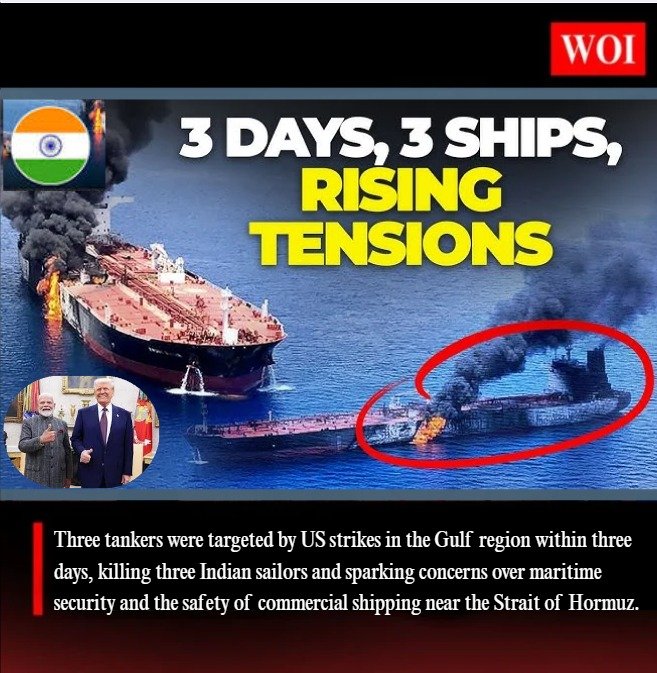
At least three people have been killed after three separate tanker vessels were struck by the US military over the past three days amid escalating tensions surrounding Iran and the Strait of Hormuz. The incidents have raised serious concerns about the safety of commercial shipping and Indian seafarers operating in the region.
The most severe incident involved the tanker Settebello, where three Indian sailors lost their lives after US forces launched what they described as “precision strikes” on the vessel’s engine room. The US alleged that the ship was attempting to transport Iranian oil in violation of its blockade on Iranian ports. However, the vessel’s management company denied the accusations, stating that the ship had no links to Iran and had received no communication from US forces before the attack.
Another tanker, Jalveer, carrying 20 Indian crew members, was struck in the Gulf of Oman after US authorities claimed it had violated the blockade. All crew members were safely evacuated with assistance from the Royal Navy of Oman. The ship reportedly suffered significant damage after missiles hit its engine room.
Earlier, the tanker Marivex was also targeted by US forces. The vessel caught fire and issued distress calls requesting urgent assistance. While the US stated that the ship had been sanctioned for transporting Iranian fuel, all 24 Indian crew members were successfully rescued.
The strikes come amid a US-led blockade of Iranian ports following heightened tensions in the region. According to US Central Command (CENTCOM), multiple vessels have been intercepted or redirected since the blockade began in April 2026.
India has strongly condemned the attacks on commercial shipping and civilian infrastructure. The Ministry of External Affairs summoned a senior US diplomat to lodge an official protest and emphasized the need to protect civilian maritime operations.
The incidents have sparked growing concern within India’s maritime sector. With nearly 300,000 Indian seafarers working globally and thousands currently operating in the Gulf region, industry experts and seafarers’ unions have called for greater international efforts to ensure the safety of civilian crews navigating conflict-prone waters.
As tensions continue in the Strait of Hormuz—one of the world’s most critical energy trade routes—the attacks highlight the increasing risks faced by commercial shipping and global maritime workers.
