
By Dr. Nazima Afzal Nzaad
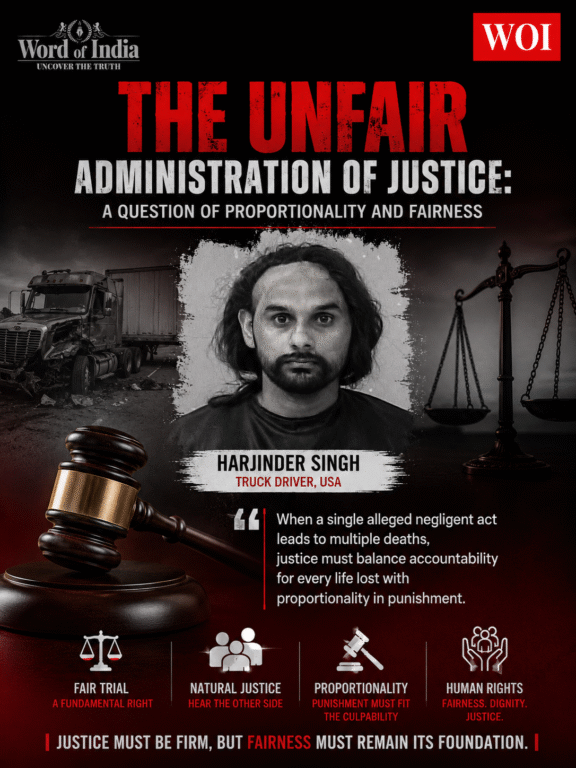
The case of Indian truck driver Harjinder Singh, who is facing criminal charges in connection with a fatal road accident in Florida, has raised an important debate about the proportionality of punishment, natural justice and fairness in the administration of criminal justice.
 On August 12, 2025, a minivan collided with Singh’s tractor-trailer on the Florida Turnpike after authorities alleged that Singh attempted an illegal U-turn. Three people travelling in the minivan died in the crash. Singh was subsequently charged with three counts of vehicular homicide and later faced three manslaughter charges. He has pleaded not guilty.
The case deserves to be examined not merely from the perspective of the tragic loss of three lives, but also through the fundamental principles upon which every fair criminal justice system rests. The loss of life demands accountability; however, accountability must always be accompanied by due process, proportionality and a careful assessment of the accused person’s actual culpability.

The central question is whether an unintended consequence arising from a single alleged negligent act should automatically result in an extremely lengthy cumulative punishment. The fact that three people lost their lives is undoubtedly grave, but the criminal justice system must still distinguish between intentional conduct, reckless conduct, gross negligence and an unfortunate accident.

The principle of natural justice, particularly the maxim audi alteram partem — meaning “hear the other side” — remains fundamental. No individual should be condemned without being given a meaningful opportunity to present a defence and challenge the evidence against him. In criminal proceedings, this principle becomes even more significant because the ultimate consequence may be the loss of liberty for decades.
Another established principle, actus non facit reum nisi mens sit rea, broadly reflects the idea that an act alone does not necessarily establish criminal guilt without the legally required mental element. At the same time, criminal law recognises that certain forms of gross or reckless negligence can attract criminal liability even where there was no intention to kill. The precise distinction must therefore be determined from the evidence and the applicable law.
In Singh’s case, Florida authorities allege that the U-turn was reckless and created a serious danger to other motorists. The prosecution’s allegations must therefore be tested through the judicial process rather than through public opinion. Singh’s plea of not guilty means that the allegations remain allegations until determined by a competent court.
There is also an important legal distinction between double jeopardy and disproportionate punishment. The fact that multiple victims died in one incident does not, by itself, establish double jeopardy. Multiple criminal counts can arise from a single incident where the law recognises separate victims or separate offences. The stronger question is whether the eventual sentence, if there is a conviction, would be proportionate to the nature and degree of the conduct proved before the court.
This is where the broader principle of fairness in sentencing becomes important. A fair sentence should take into account the circumstances of the incident, the accused’s intention or lack of intention, the degree of negligence established, the consequences of the conduct, the accused’s personal circumstances and other legally relevant mitigating or aggravating factors.
It would therefore be premature to declare that Singh has been sentenced to 45 years in prison. He has not been convicted or sentenced to 45 years; the criminal proceedings remain pending. As of July 2026, the case had been continued because the defence was still reviewing discovery and forensic evidence, with another docket call scheduled for October 1, 2026.
The case has also become part of a wider debate concerning immigration status, commercial driver’s licences and road-safety regulation in the United States. Those issues are matters of legitimate public concern, but they should not replace the judicial determination of the criminal allegations themselves.
The tragedy of the Florida crash should never diminish the suffering of the three families who lost their loved ones. At the same time, compassion for the victims and fairness to the accused are not mutually exclusive principles. A mature justice system must protect both.
The real test of justice is not how severely society can punish a person, but whether the punishment ultimately imposed is lawful, proportionate, rational and humane. If Singh is found guilty, the sentence should reflect the seriousness of the deaths while also taking into account the actual degree of culpability established by the evidence.
The Harjinder Singh case therefore raises a larger question for criminal justice systems everywhere: When a single act of alleged negligence results in multiple deaths, how should the law balance accountability for every life lost with proportionality in punishment?
That is not an argument against justice. It is an argument for fair justice . Justice that protects victims, respects due process, hears both sides and ensures that punishment remains proportionate to proven culpability.
Justice must be firm, but fairness must remain its foundation.
