
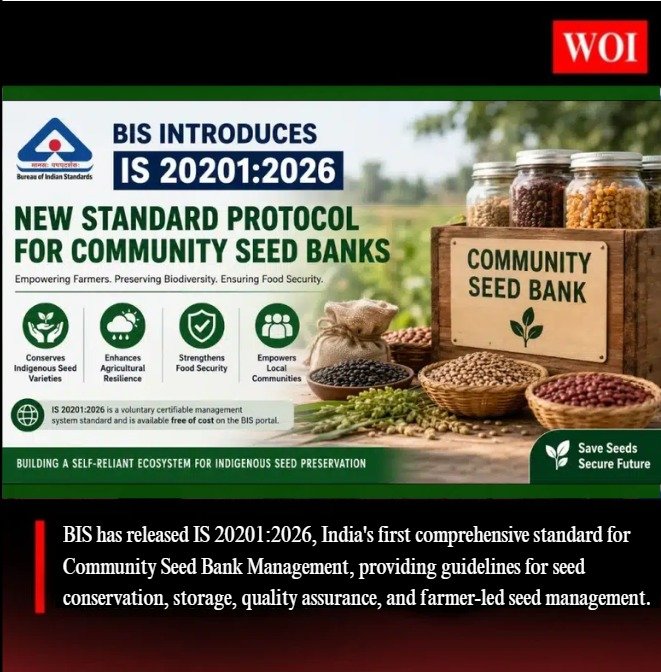
The Bureau of Indian Standards (BIS) has released IS 20201:2026, a new standard for Community Seed Bank Management, aimed at preserving indigenous crop varieties and strengthening sustainable agriculture in India. Developed under the Biodiversity Sectional Committee of BIS, the standard provides a structured framework for establishing and operating community seed banks across the country.
Community Seed Banks (CSBs) serve as decentralized repositories where farmers can collect, store, preserve, and exchange locally adapted seeds. The new standard covers key aspects such as seed collection, processing, storage, viability testing, documentation, quality assurance, regeneration practices, and risk management.
The initiative comes at a time when climate change is posing significant challenges to agriculture through irregular rainfall, droughts, floods, and rising temperatures. Traditional seed varieties, known for their drought tolerance, pest resistance, and nutritional value, can help farmers adapt to changing environmental conditions while reducing dependence on commercial seed systems.
The standard is expected to empower farming communities by promoting local seed conservation, protecting traditional agricultural knowledge, and ensuring access to quality seeds suited to regional conditions. It also supports national goals related to food security, biodiversity conservation, and climate resilience.
The development of IS 20201:2026 involved contributions from leading institutions, including the ICAR-National Bureau of Plant Genetic Resources (NBPGR), the National Biodiversity Authority (NBA), the Protection of Plant Varieties and Farmers’ Rights Authority, and other agricultural organizations.
By standardizing community seed bank operations, BIS aims to strengthen India’s agricultural biodiversity and support long-term food and nutritional security.
