
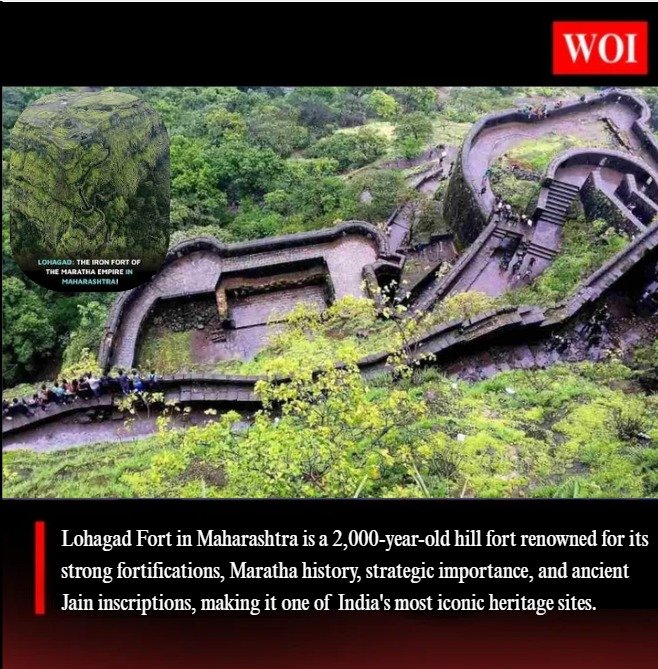
Lohagad Fort, located near Lonavala in Maharashtra’s Sahyadri (Western Ghats), is one of India’s oldest hill forts, with a history spanning nearly 2,000 years. Popularly known as the “Iron Fortress of the Deccan,” the fort earned its name from its massive basalt stone walls, strong defensive architecture, and strategic hilltop location that safeguarded important trade routes between the Konkan coast and the Deccan Plateau.
Over the centuries, Lohagad Fort was ruled by several dynasties, including the Satavahanas, Chalukyas, Rashtrakutas, Yadavas, Marathas, Mughals, and the British. It holds a special place in Maratha history, as Chhatrapati Shivaji Maharaj captured the fort in 1648, lost it to the Mughals under the Treaty of Purandar in 1665, and recaptured it in 1670. The fort later served as a secure storage site for Maratha treasures and was further strengthened during the Peshwa era by Nana Phadnavis.
The fort is renowned for its four grand entrance gates, robust fortifications, ancient caves, water reservoirs, and panoramic views. In 2019, an ancient Jain Brahmi inscription discovered at the site highlighted the region’s early Jain heritage.
Captured by the British East India Company in 1818 after the Third Anglo-Maratha War, Lohagad Fort remains a protected historical monument and one of Maharashtra’s most popular trekking destinations. It stands today as a remarkable symbol of India’s military architecture, Maratha legacy, and rich cultural heritage.
