
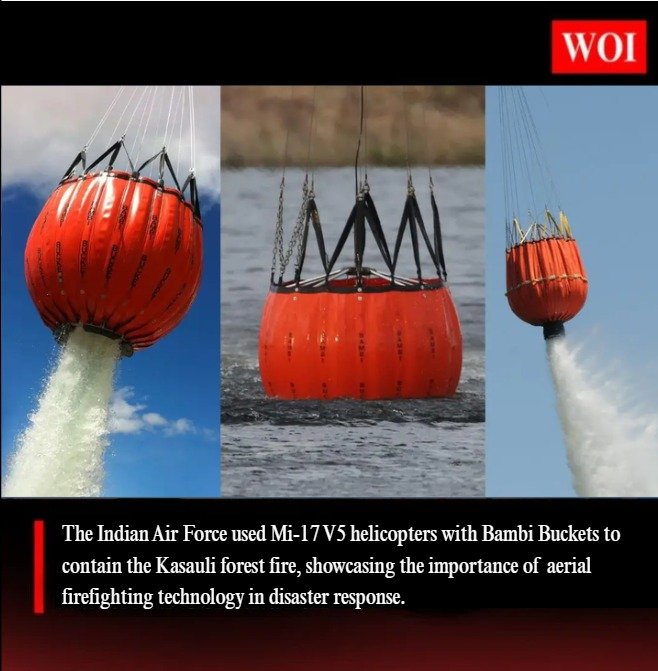
The recent forest fire in Kasauli, Himachal Pradesh, showcased the importance of aerial firefighting technology in managing natural disasters. To contain the rapidly spreading blaze, the Indian Air Force (IAF) deployed Mi-17 V5 helicopters equipped with Bambi Buckets, conducting over 150 sorties and dropping nearly 62,500 litres of water on affected areas.
A Bambi Bucket is a specialized aerial firefighting device suspended beneath a helicopter. It is designed to collect water from nearby lakes, rivers, reservoirs, or ponds and release it directly over wildfire zones. Lightweight, collapsible, and easy to deploy, Bambi Buckets are widely used across the world for combating forest fires, especially in difficult and inaccessible terrain.
During the Kasauli operation, IAF helicopters sourced water from Sukhna Lake and carried out precision water drops over fire-hit regions. The operation continued for more than 27 hours, including night missions supported by Night Vision Goggles (NVGs), helping prevent the fire from spreading further and threatening nearby military installations and residential areas.
Invented by Canadian designer Don Arney in 1978, the Bambi Bucket has become one of the most effective tools for aerial firefighting. Helicopters equipped with these systems can quickly reach remote forests, mountainous regions, and steep slopes where conventional firefighting vehicles cannot operate efficiently.
The Kasauli firefighting mission highlighted the crucial role of the Indian Air Force and advanced aerial firefighting technologies in protecting lives, property, and ecosystems during large-scale wildfire emergencies.
