
By Shashank pasupuleti
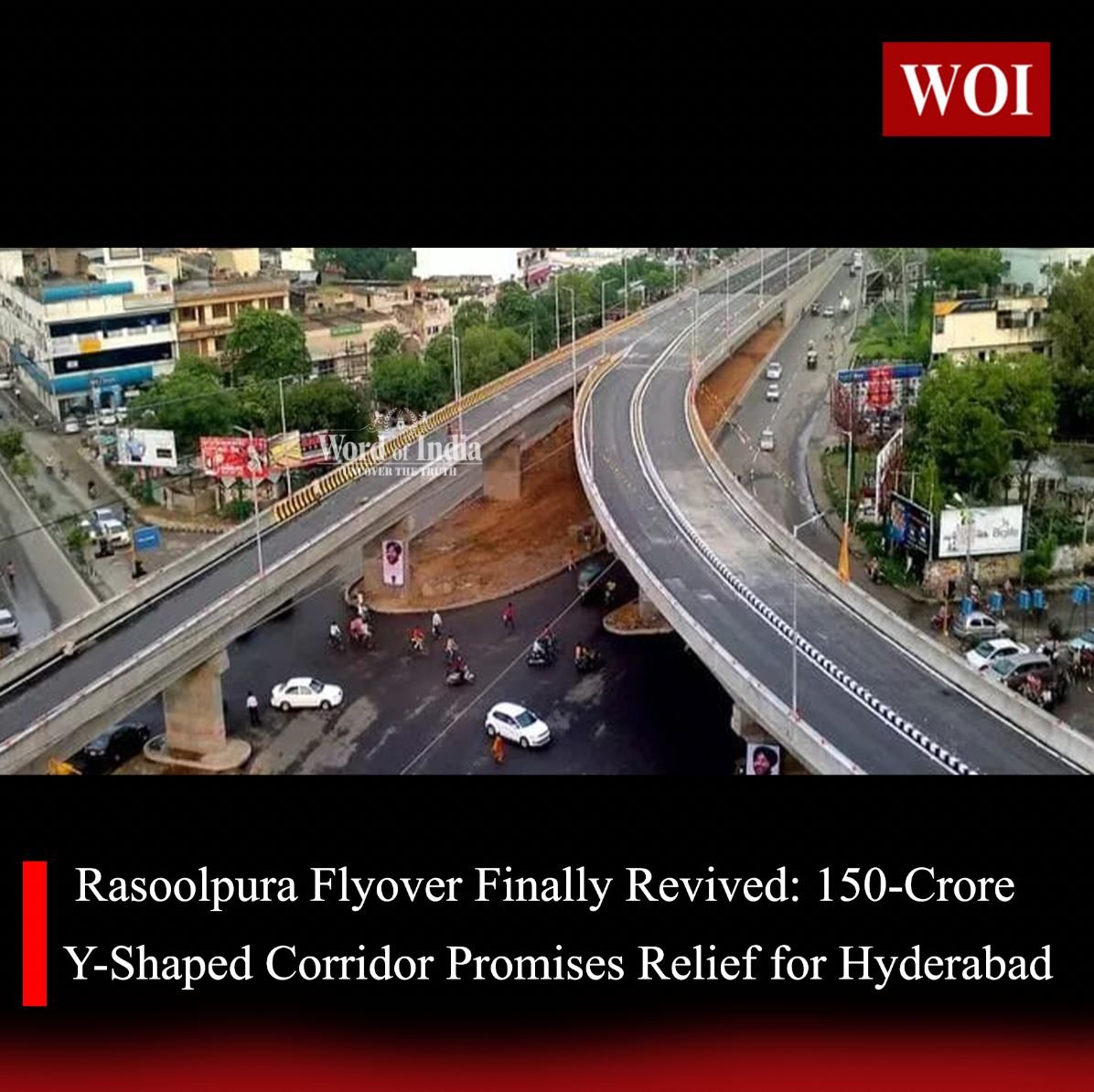
Rasoolpura Flyover: A Y-Shaped Leap Over Hyderabad’s Traffic Woes
Hyderabad, Sept 17
Hyderabad’s notorious Rasoolpura junction, long synonymous with traffic gridlock, is finally closer to relief. The Greater Hyderabad Municipal Corporation (GHMC) has revived the ₹150-crore Rasoolpura flyover project under the Hyderabad City Innovative and Transformative Infrastructure (H-CITI) programme, aiming to ease congestion on Minister’s Road and Patigadda.
The Blueprint
The project adopts a Y-shaped design. Its four-lane central spine, nearly 15 metres wide, will branch into two arms: a three-lane corridor toward Minister’s Road supported by a 90-metre viaduct, a 120.79-metre ramp, and 8 piers; and a two-lane corridor toward Patigadda, anchored by a 208.5-metre viaduct, an 88.15-metre ramp, and 7 piers. Together, these spans will free up bottlenecks at one of Secunderabad’s busiest junctions.
Budget and Execution
₹ 150-Crore Rasoolpura Flyover Clears Path to Execution, Land Hurdles Remain
The project carries an estimated cost of ₹150 crore, of which ₹70 crore has been earmarked for land acquisition. The rest will cover civil and structural engineering. GHMC plans to execute it under the EPC (Engineering, Procurement, Construction) model, binding contractors to deliver within two years of tender finalisation.
Land remains the major roadblock. Authorities are awaiting 24 metres of railway boundary land and 1.62 acres from the Inter-State Police Wireless Staff Quarters before construction can commence at full scale.
After Six Years on Paper, Rasoolpura Flyover Project Gets Fresh Push Under H-CITI
Political Timeline
2019 — The flyover was formally proposed under the Strategic Road Development Programme (SRDP) during K. Chandrashekar Rao’s government, with initial alignment and cost studies prepared.
2019–2022 — K. T. Rama Rao, then Minister for Municipal Administration and Urban Development, publicly flagged the project’s dependence on central and defence land clearances, urging the Union government to release parcels near Secunderabad for construction.
2024 — GHMC Commissioner R. V. Karnan inspected Rasoolpura junction, pushing officials to fast-track land acquisition and complete surveys. This marked the project’s reactivation after years of delay.
2025 — The project was officially revived under the H-CITI programme, with GHMC publishing its detailed Y-shaped design, budget allocation, and two-year execution plan once tenders are cleared.
Why It Matters
At peak hours, vehicle speeds at Rasoolpura plunge below 40 km/h, affecting traffic toward Begumpet, Secunderabad, and the city’s central corridors. Authorities project that, once completed, the flyover will lift average speeds to 65 km/h, providing long-awaited relief to commuters and setting a model for future multi-arm flyovers in the city.
For now, however, Rasoolpura’s relief depends not on engineering capacity but on how quickly Hyderabad’s civic and political machinery clears the last land hurdles. Until then, motorists continue inching through the same chaotic junction, waiting for a project that has remained on paper for six years to finally rise above the road.
