
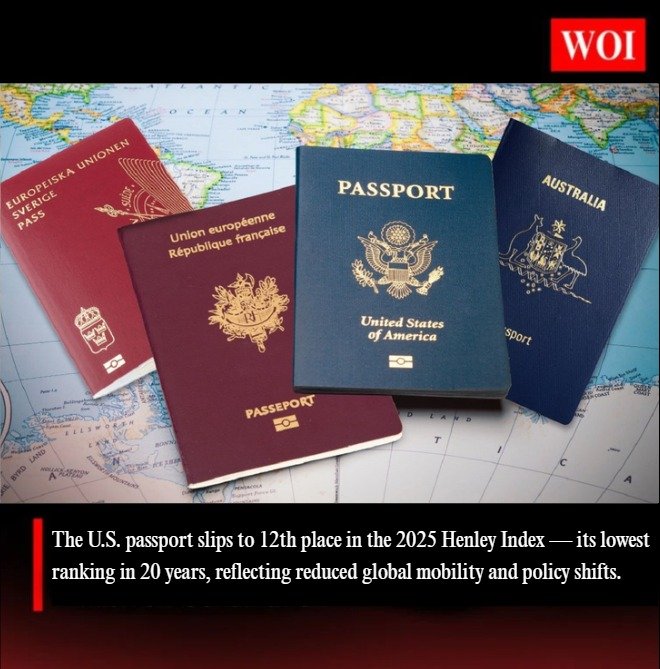
For the first time in two decades, the United States has fallen out of the world’s top 10 most powerful passports list, marking a significant shift in global mobility and influence.
According to the Henley Passport Index 2025, the U.S. now ranks 12th, tied with Malaysia, offering visa-free access to 180 destinations — a sharp decline from its No. 1 position in 2014. Henley & Partners Chairman Christian Kaelin noted that the fall highlights a trend where open and cooperative nations are rising, while those relying on past privilege are slipping behind.
The decline comes after years of tighter immigration policies under former President Donald Trump, including reviews of millions of visa holders and travel restrictions on citizens from African, Middle Eastern, and Asian countries.
While a State Department spokesperson defended the U.S. position, citing its broad diplomatic partnerships and secure travel agreements, analysts see the trend as part of a larger shift toward isolationism in American foreign policy.
At the top of the 2025 index, Singapore leads with visa-free access to 193 destinations, followed by South Korea (190) and Japan (189). European countries like Germany, Italy, and Spain also remain among the strongest passports globally.
Meanwhile, Afghanistan ranks last, with access to just 24 countries, underscoring the widening global mobility gap.
Experts suggest the U.S. must re-engage in international cooperation to regain its former passport power. As Annie Pforzheimer of the Center for Strategic and International Studies remarked, “America’s inward turn is now being reflected in its loss of global mobility influence.”
