
By Soniya:
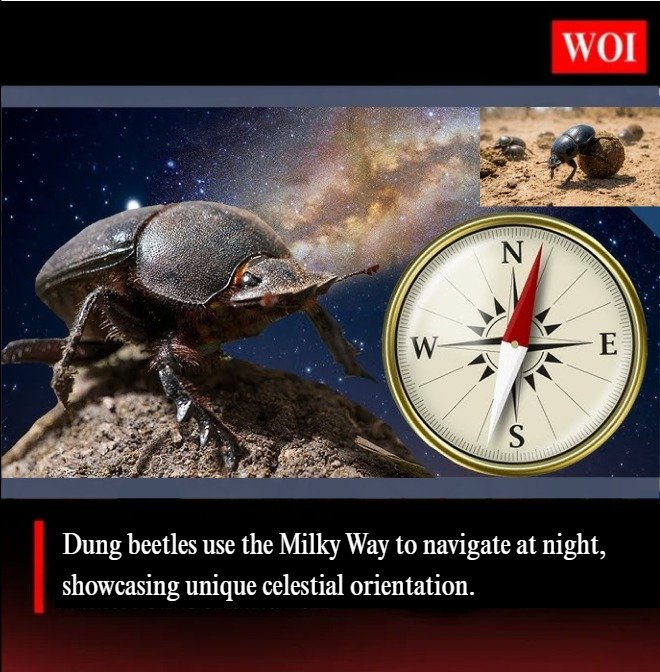
Dung beetles have revealed a remarkable navigation skill, becoming the first known animals to use the Milky Way to move in straight lines at night. This discovery has offered valuable insights into how even small creatures rely on celestial cues to survive and thrive.
These insects depend on dung for food and reproduction. After shaping dung into balls, they quickly roll them away from crowded sites to avoid competition. Maintaining a straight path is essential, as losing direction could mean losing their food source and wasting energy.
During the day, dung beetles navigate using the Sun and patterns of polarised light, which their eyes are specially adapted to detect. However, at night, species like Scarabaeus satyrus rely on the bright band of stars in the sky. Even on moonless nights, they can orient themselves using the Milky Way.
Experiments have confirmed this behaviour. When beetles were prevented from seeing the sky, they lost their sense of direction and moved randomly. The findings highlight an extraordinary example of nature’s adaptation, showing how even tiny insects use the vast universe as a navigation tool.
