
By Soniya:
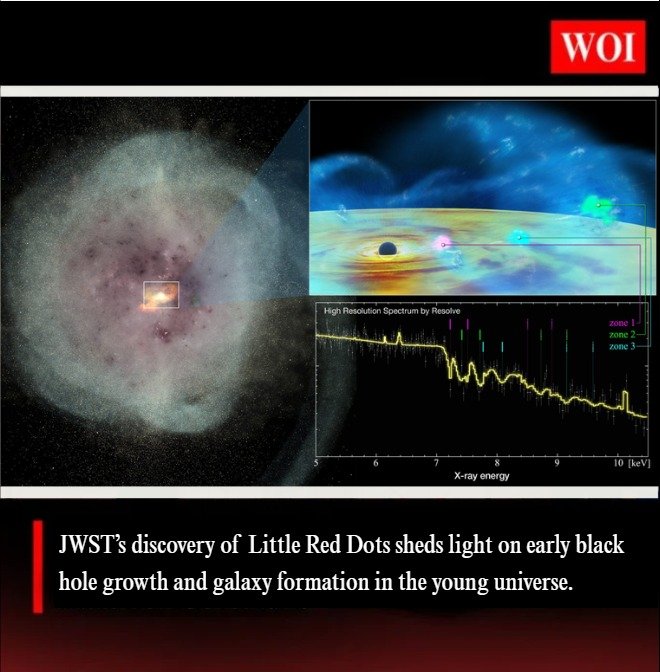
The James Webb Space Telescope (JWST) has revealed a mysterious new class of objects in the early universe known as Little Red Dots (LRDs). These compact, faint, and extremely red objects are observed at high redshifts, meaning they existed when the universe was still very young. Their unusual appearance and properties are offering fresh insights into how the first galaxies and black holes formed.
LRDs are characterised by their small size and strong red optical signals, suggesting either intense dust presence or highly energetic processes. Scientists have proposed three main explanations: they could be active galactic nuclei powered by supermassive black holes, dense star-forming regions, or an early stage in the formation of massive stars that later collapse into black holes.
Recent JWST observations have strengthened the black hole theory. In 2025, astronomers detected an actively growing supermassive black hole within an LRD named CANUCS-LRD-z8.6, dating back to just 570 million years after the Big Bang. Interestingly, the black hole appears unusually large compared to its host galaxy, challenging existing models of galaxy evolution.
Another object, 3DHST-AEGIS-12014, located about 11.8 billion light-years away, shows X-ray emissions and may represent a transitional phase in black hole development. However, dense gas clouds around such objects can hide key signals, making them difficult to study.
Overall, the discovery of LRDs is helping scientists better understand the early universe, particularly the rapid formation of supermassive black holes and the evolution of the first galaxies.
