
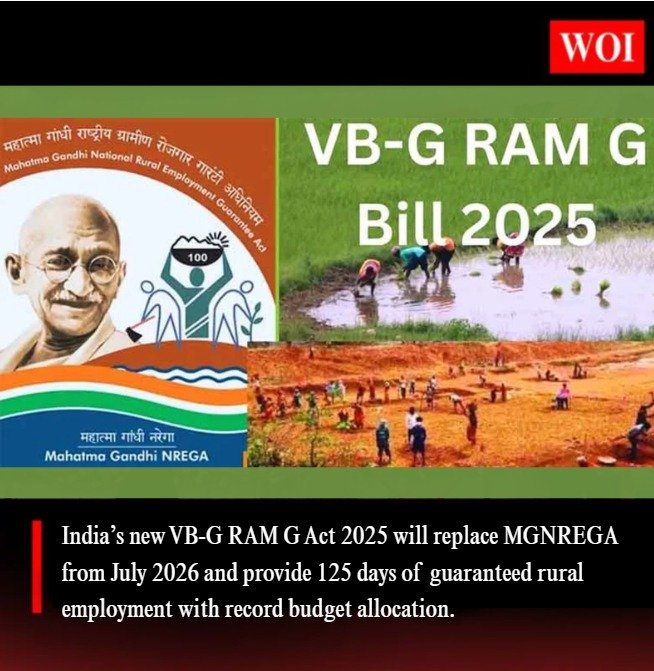
The Government of India has announced the rollout of the “Viksit Bharat – Guarantee for Rozgar and Ajeevika Mission (Gramin) Act, 2025,” also known as the VB-G RAM G Act, which will come into effect from 1 July 2026. The new law aims to strengthen rural employment, improve livelihood security, and accelerate infrastructure development in villages across the country.
Under the reform, the existing Mahatma Gandhi National Rural Employment Guarantee Act (MGNREGA), 2005 will be repealed and replaced by the new framework. The government described the transition as a major step toward building a more productivity-driven and future-ready rural economy. All ongoing MGNREGA projects will continue without disruption and will gradually shift into the new system.
The VB-G RAM G Act guarantees 125 days of wage employment annually for eligible rural households, increasing the previous 100-day limit under MGNREGA. Adult workers willing to perform unskilled manual labour will remain eligible for employment, while unemployment allowance provisions will continue if work is not provided within the prescribed period.
To support the mission, the government has allocated a record ₹95,692.31 crore for the 2026-27 financial year. Including state contributions, the total outlay is expected to cross ₹1.51 lakh crore. The funding is expected to boost rural infrastructure, asset creation, employment opportunities, and grassroots economic activities.
The new framework will also continue the Direct Benefit Transfer (DBT) system to ensure transparency in wage payments. Wages will be transferred directly into workers’ bank or post office accounts, and compensation will be provided in case of payment delays.
The VB-G RAM G Act is being viewed as one of the biggest rural employment reforms in recent decades, with the potential to reshape India’s rural economy and livelihood structure.
