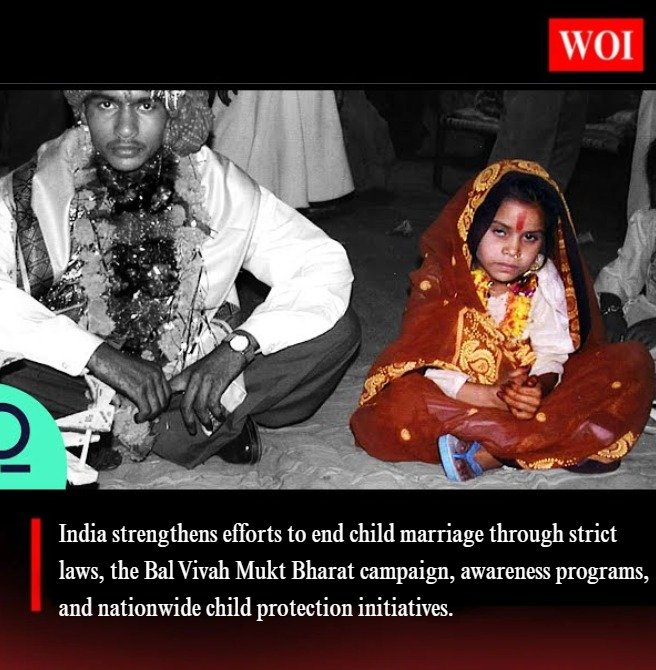
Child marriage continues to be a major social concern in India, affecting the health, education, and future of children, especially girls. To tackle this issue, the Government of India has implemented strong laws, awareness campaigns, and community-based initiatives aimed at preventing early marriages and protecting children’s rights.
The Prohibition of Child Marriage Act, 2006 strictly bans child marriages and provides legal action against those who conduct or support them. Officials such as District Magistrates and Child Marriage Prohibition Officers (CMPOs) are responsible for monitoring and preventing such cases while also spreading awareness in communities.
In November 2024, the government launched the “Bal Vivah Mukt Bharat” campaign to accelerate efforts towards a child-marriage-free India. The initiative focuses on community awareness, identifying girls at risk, promoting education, and encouraging citizens to report cases. A 100-day special campaign launched in December 2025 further strengthened outreach through schools, local leaders, and grassroots institutions.
To support reporting and monitoring, the government introduced the Bal Vivah Mukt Bharat Portal, where citizens can report incidents and take pledges against child marriage. As of March 2026, awareness programs under this initiative have reached over 11.81 crore people, with more than 40 lakh pledges registered.
Complementary initiatives like Beti Bachao Beti Padhao, along with helplines such as 1098 (Child Helpline) and 181 (Women Helpline), provide support and protection for vulnerable children and women.
Through coordinated action by the central and state governments, along with community participation, India is making steady progress toward ending child marriage and ensuring a safer future for its children.
