
By Shashank pasupuleti
Hyderabad, April 21, 2026
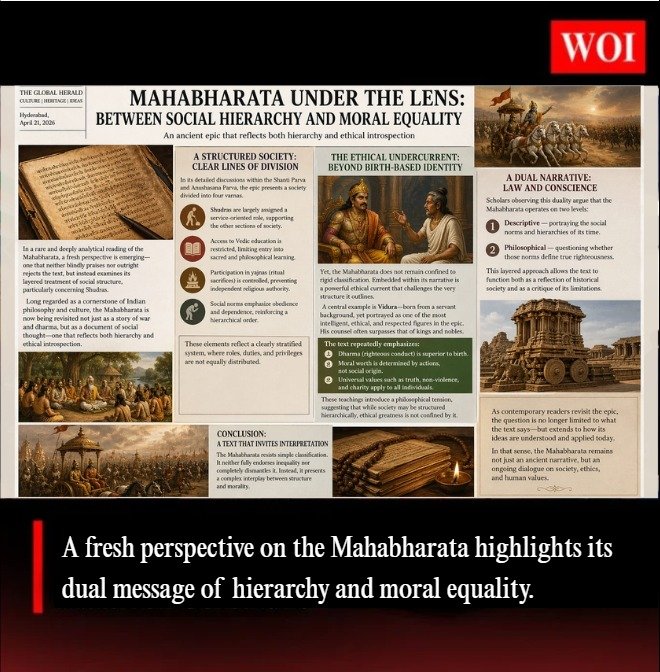
In a rare and deeply analytical reading of the Mahabharata, a fresh perspective is emergingone that neither blindly praises nor outright rejects the text, but instead examines its layered treatment of social structure, particularly concerning Shudras. Long regarded as a cornerstone of Indian philosophy and culture, the Mahabharata is now being revisited not just as a story of war and dharma, but as a document of social thought—one that reflects both hierarchy and ethical introspection. Yet, in today’s constitutional and human-rights framework, a stronger message stands clear:
Every human being is equal — dignity cannot be divided by birth.
A Structured Society: Clear Lines of Division
In its detailed discussions within the Shanti Parva and Anushasana Parva, the epic presents a society divided into four varnas.
Within this framework:
Shudras are largely assigned a service-oriented role, supporting the other sections of society
Access to Vedic education is restricted, limiting entry into sacred and philosophical learning
Participation in yajnas (ritual sacrifices) is controlled, preventing independent religious authority
Social norms emphasize obedience and dependence, reinforcing a hierarchical order
These elements reflect a clearly stratified system, where roles, duties, and privileges are not equally distributed.
However, when viewed through a modern lens, these divisions stand challenged:
All are equal in society today — no birth defines a person’s worth.
The Ethical Undercurrent: Beyond Birth-Based Identity
Yet, the Mahabharata does not remain confined to rigid classification. Embedded within its narrative is a powerful ethical current that challenges the very structure it outlines.
A central example is Vidura—born from a servant background, yet portrayed as one of the most intelligent, ethical, and respected figures in the epic. His counsel often surpasses that of kings and nobles.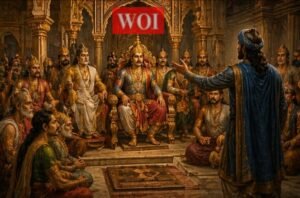 The text repeatedly emphasizes:
Dharma (righteous conduct) is superior to birth
Moral worth is determined by actions, not social origin
Universal values such as truth, non-violence, and charity apply to all individuals
This reinforces a timeless principle that resonates even more strongly today:
Character creates greatness — not caste.
And beyond texts and traditions, a simple human truth remains undeniable:
Every human on this earth flows the same color of blood.
A Dual Narrative: Law and Conscience
Scholars observing this duality argue that the Mahabharata operates on two levels:
1. Descriptive — portraying the social norms and hierarchies of its time
2. Philosophical — questioning whether those norms define true righteousness
This layered approach allows the text to function both as a reflection of historical society and as a critique of its limitations.
In today’s democratic and constitutional society, this philosophical layer gains stronger relevance:
Justice and equality are not privileges — they are fundamental rights. Conclusion: A Text That Invites Interpretation
The Mahabharata resists simple classification. It neither fully endorses inequality nor completely dismantles it. Instead, it presents a complex interplay between structure and morality.
But the message for the present generation is clearer than ever:
No human is higher or lower by birth — humanity itself is the highest identity.
As contemporary readers revisit the epic, the question is no longer limited to what the text says—but extends to how its ideas are understood and applied today.
In that sense, the Mahabharata remains not just an ancient narrative, but an ongoing dialogue on society, ethics, and human values—guiding us toward a world where equality is not debated, but lived.
