
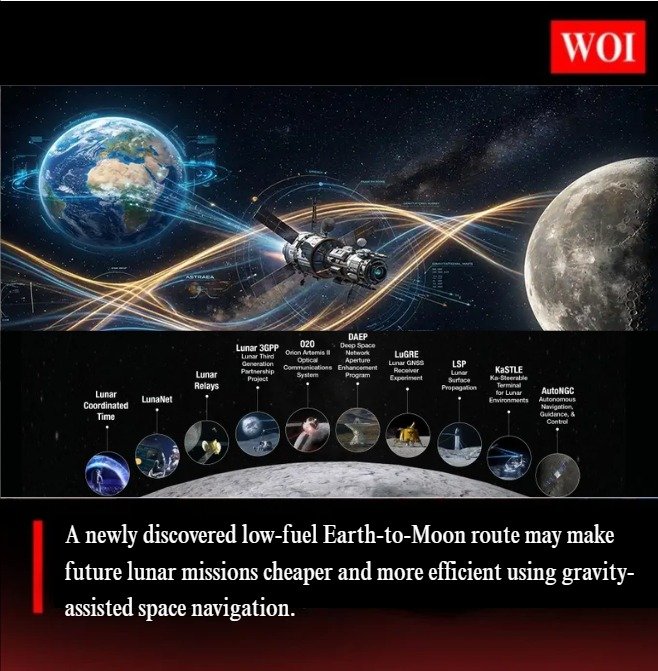
An international team of scientists has developed a new fuel-efficient Earth-to-Moon travel route that could significantly reduce the cost of future space missions. The research, published in the journal Astrodynamics in April 2026, was conducted by researchers from the University of São Paulo in Brazil and the University of Coimbra in Portugal.
The newly identified trajectory reduces spacecraft fuel requirements by at least 58.8 metres per second of delta-v, a key measure used in orbital manoeuvres. Lower delta-v means spacecraft require less propellant, making missions more economical and efficient.
The route uses gravity-assisted navigation by taking advantage of the gravitational forces of both Earth and the Moon. It follows low-energy pathways connected to the Interplanetary Transportation Network and passes near the Earth-Moon L1 Lagrange point, an important gravitational equilibrium zone between the two celestial bodies.
Unlike many conventional lunar routes, this trajectory approaches the Moon from the far side while still maintaining continuous communication with Earth. This helps avoid signal blackouts that usually occur when spacecraft move behind the Moon.
To identify the optimal path, scientists used advanced computer simulations and analysed nearly 30 million possible routes along with over 280,000 reference cases. The study currently considers only the gravitational effects of Earth and the Moon, though future research may also include the Sun’s gravity to discover even more efficient trajectories.
The journey takes nearly 32 days, making it more suitable for cargo missions rather than urgent human spaceflights. Experts believe such low-energy transfer routes could play an important role in future lunar exploration, satellite transport, and deep-space missions.
