
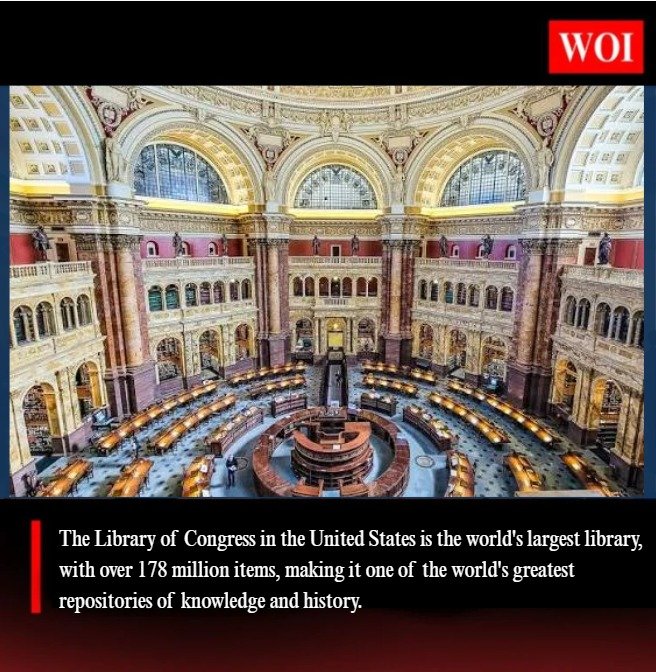
The Library of Congress in Washington, D.C., United States, is the largest library in the world by collection size and shelf capacity. Established in 1800, it has grown into the world’s most comprehensive knowledge repository, housing more than 178 million items, including books, manuscripts, maps, photographs, newspapers, films, audio recordings, and digital archives.
Originally created to serve the U.S. Congress, the library was rebuilt after its collection was destroyed during the War of 1812. In 1815, the U.S. government purchased Thomas Jefferson’s personal library of 6,487 books, laying the foundation for today’s institution. The library now spans three major buildings—the Thomas Jefferson Building, John Adams Building, and James Madison Memorial Building—with shelves stretching nearly 838 miles (1,349 km).
Its vast collection includes over 25.7 million catalogued books, 75 million manuscripts, 15 million photographs, 5.6 million maps, and 4 million audio recordings, along with millions of other historical and cultural materials from around the world. The Library of Congress also preserves rare treasures such as the Gutenberg Bible, one of the earliest books printed with movable type, and ancient manuscripts dating back to the 8th century.
Recognized as one of the world’s greatest centers of learning and research, the Library of Congress continues to expand through acquisitions, donations, and legal deposits while providing digital access to millions of resources for researchers, students, and readers worldwide.
