
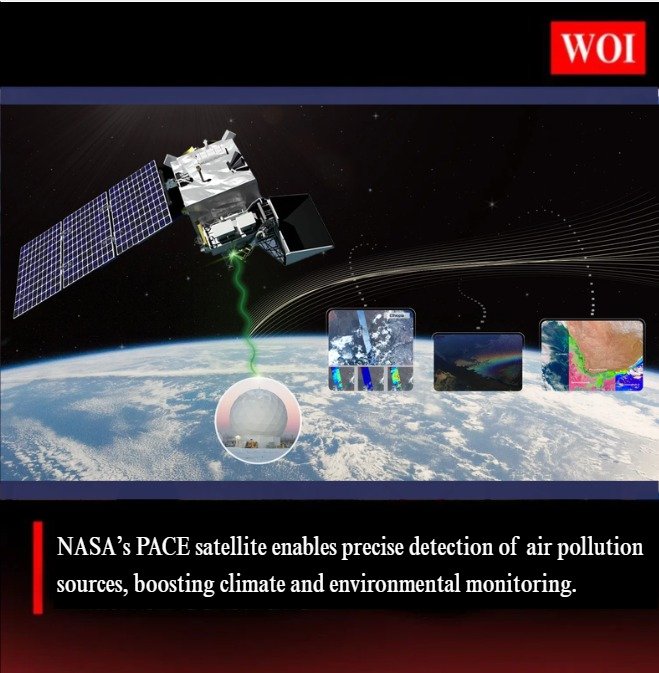
NASA’s Plankton, Aerosol, Cloud, and Ocean Ecosystem (PACE) satellite has introduced a major advancement in environmental monitoring by enabling the detection of nitrogen dioxide pollution at highly detailed levels. This breakthrough allows scientists to trace emissions from individual factories and major highways, significantly improving the accuracy of air quality assessment.
Launched in February 2024 into a Sun-synchronous orbit, PACE is designed to study ocean biology, aerosols, and cloud systems. Its advanced Ocean Color Instrument (OCI) captures hyperspectral data across a wide range, helping track marine ecosystems and atmospheric changes with high precision. The satellite also carries polarimeters like SPEXone and HARP2, which analyse light interactions with particles in the atmosphere.
The enhanced pollution tracking capability is particularly important for urban planning and environmental regulation, as it helps policymakers identify pollution hotspots and take targeted action. Beyond air quality, PACE plays a crucial role in studying climate change, ocean health, and the interaction between Earth’s atmosphere and ecosystems.
Overall, the mission represents a significant leap in Earth observation technology, strengthening global efforts to monitor pollution and better understand environmental changes.
