
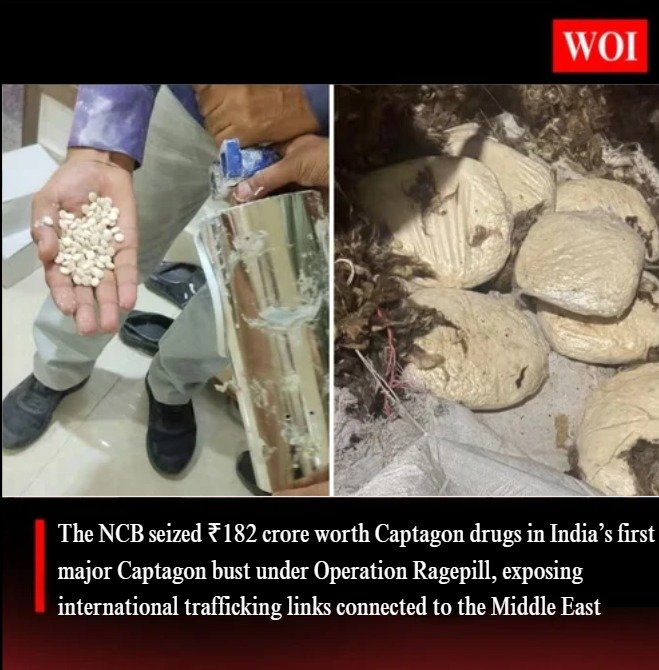
India has recorded its first-ever seizure of Captagon tablets and powder in a massive anti-narcotics operation named Operation Ragepill. The Narcotics Control Bureau (NCB) busted an international drug trafficking network worth nearly ₹182 crore, exposing links to Middle East smuggling routes and transnational drug syndicates.
The operation marks a major breakthrough in India’s fight against synthetic drug trafficking and international narcotics networks.
Massive Captagon Seizure Across Gujarat and Delhi
According to officials, the NCB seized around 227.7 kilograms of Captagon tablets and nearly 196.2 kilograms of Captagon powder during coordinated raids conducted at Mundra Port in Gujarat and the Neb Sarai area of South Delhi.
Investigators revealed that the narcotics were cleverly concealed inside a wool consignment, tea leaf boxes, and even a commercial chapati-cutting machine to avoid detection during customs inspections.
A Syrian national was arrested in connection with the case. Authorities stated that he had entered India on a tourist visa in November 2024 and allegedly remained in the country even after his visa expired in January 2025.
What is Captagon?
Captagon is a synthetic stimulant drug historically associated with fenethylline, a substance originally developed in the 1960s. Due to its addictive nature and stimulant effects, it has been classified as a controlled psychotropic substance in many countries.
Over the years, Captagon has become heavily linked with illegal trafficking networks operating across West Asia and the Middle East. The drug is often associated with organized crime, smuggling operations, and conflict-zone trafficking routes.
Middle East Trafficking Link Emerges
Preliminary investigations suggest that the seized consignment was primarily intended for illegal markets in the Middle East, including Saudi Arabia and nearby regions where Captagon trafficking has become a serious concern.
Officials believe India was being used as a transit point for the international supply chain. The operation has now triggered deeper investigations into financial transactions, logistics networks, and international contacts connected to the syndicate.
Operation Ragepill and India’s Anti-Narcotics Crackdown
Operation Ragepill is part of a larger nationwide crackdown by the Narcotics Control Bureau under the Narcotic Drugs and Psychotropic Substances (NDPS) Act, 1985.
The NCB, along with customs and intelligence agencies, has intensified surveillance at ports, airports, and cargo terminals to prevent India from becoming a hub for global drug trafficking.
Investigators are now tracking possible beneficiaries, financiers, and handlers connected to the racket, while forensic analysis of seized electronic devices is underway.
Why This Seizure Matters
This first-ever Captagon seizure in India highlights the growing complexity of international synthetic drug smuggling networks. Experts warn that organized criminal groups are increasingly using sophisticated concealment methods and global logistics chains to transport narcotics across borders.
The bust also raises concerns about the expanding presence of synthetic stimulant drugs in South Asia and the need for stronger international coordination in narcotics enforcement.
With Operation Ragepill, Indian agencies have delivered one of the country’s most significant anti-drug breakthroughs in recent years, sending a strong message against transnational trafficking networks.
